
How Many Marks Do You Need for an A* in IGCSE Chemistry? February/March 2027, India
The March A* threshold has moved between 157 and 177 of 200 since 2023. Here is what that means per paper, and how to clear it.

TL;DR: In March 2026 an A* in Cambridge IGCSE Chemistry 0620 on the Extended route needed 172 of 200 weighted marks, and over the last four March series the A* line has sat anywhere between 157 and 177. That is 86% to 88.5% of the paper in the two most recent years, which works out at roughly 35 out of 40 on Paper 2, 70 out of 80 on Paper 4 and 35 out of 40 on Paper 6. The March 2027 series runs from 3 February to 4 March, and Chemistry's theory paper falls on Friday 5 February, the third day of the window, so the syllabus has to be finished by January, not February. Below are the four-year threshold table, the per-paper targets, the three places Chemistry students lose the A*, and the order of work from mid-October.
On this page
- How many marks do you need for an A* in IGCSE Chemistry in the March series?
- Is the IGCSE Chemistry March paper easier than June?
- What an A* looks like on each paper
- When are the IGCSE Chemistry 0620 exams in February/March 2027?
- The theory paper is on day three: finish the syllabus by January
- Where Chemistry students lose the marks that cost the A*
- Paper 6: the 40 marks you can bank before February
- The order of work from now to 5 February
- FAQ
How many marks do you need for an A* in IGCSE Chemistry in the March series?
In March 2026 an A* in IGCSE Chemistry 0620 on the Extended route (Papers 2, 4 and 6) needed 172 of 200 weighted marks, an A needed 145, a B 117 and a C 89. Those figures are published in the Cambridge grade thresholds for IGCSE Chemistry 0620, March 2026, and they are the numbers to pin above your desk, because they turn "I want an A*" into a mark you can measure every practice paper against.
One series on its own can mislead you, though. The March line moves, and it has moved a long way. Here are the four most recent March series side by side, all for the same Extended-with-Paper-6 combination that nearly every school in India enters.
| March series | A* | A | B | C | Paper 2, grade A | Paper 4, grade A | Paper 6, grade A |
|---|---|---|---|---|---|---|---|
| March 2023 | 157 | 135 | 113 | 91 | 28 / 40 | 53 / 80 | 27 / 40 |
| March 2024 | 164 | 136 | 108 | 81 | 30 / 40 | 51 / 80 | 27 / 40 |
| March 2025 | 177 | 154 | 126 | 99 | 32 / 40 | 61 / 80 | 30 / 40 |
| March 2026 | 172 | 145 | 117 | 89 | 31 / 40 | 56 / 80 | 28 / 40 |
Overall thresholds are weighted marks out of 200 for components 22, 42 and 62. Paper columns show the raw mark for grade A on each component (Cambridge does not award A* at paper level). Sources: Cambridge grade threshold tables for 0620, March 2023, March 2024, March 2025 and March 2026.
Read the A* column from top to bottom: 157, 164, 177, 172. That is a 20-mark swing in two years. Cambridge sets the threshold after the papers are marked, so that the standard needed for an A* stays the same from series to series. A higher threshold means the paper was more accessible and the cohort scored more; a lower one means the opposite. What it never means is that the grade got easier or harder.
The practical consequence is simple. Do not train towards last year's number. Train towards the top of the range, 177, and treat anything between 172 and 177 as the real target for March 2027. If you want the June and November picture to compare against, my IGCSE Chemistry grade boundaries guide tabulates those series paper by paper; this post is the March companion to it.
Is the IGCSE Chemistry March paper easier than June?
No. In March 2026 an A* needed 172 of 200; in June 2026 the same component combination needed 169, and in June 2025 it needed 173. Those three figures come from the Cambridge threshold tables for June 2026 and June 2025, and they sit inside the same narrow band as March. If March were an easier sitting, the March threshold would be consistently higher than June's to compensate. It is not. One year it is above, the next it is below.
Students in India ask me this every autumn, usually hoping the answer is yes. In terms of difficulty, both exam sessions are equally difficult. The level of difficulty of any single paper is random, and whether it feels hard is subjective: it depends on how the student prepared and which topics they prefer. A student who has drilled moles will find a calculation-heavy Paper 4 kind; a student who has not will call the same paper brutal.
The syllabus is also identical. The Cambridge IGCSE Chemistry 0620 syllabus for 2026, 2027 and 2028 states that exams are available in the June and November series and "also available in the March series in India", with the same twelve topics, the same papers and the same assessment objectives for all three. So every June and November paper from 2023 onwards is a legitimate rehearsal for your February paper, and you should solve all of them.
What an A* looks like on each paper
An A* needs about 86% to 88.5% of the weighted total, which on the Extended route means roughly 35 out of 40 on Paper 2, 70 out of 80 on Paper 4 and 35 out of 40 on Paper 6. The arithmetic is worth seeing once, because most students have never worked out what the 200 is made of.
The 0620 syllabus assessment overview weights the three papers at 30%, 50% and 20%. Paper 2 is 40 raw marks carrying 30% of 200, so each raw mark is worth 1.5 weighted marks. Paper 4 is 80 raw marks carrying 50%, so each raw mark is worth 1.25. Paper 6 is 40 raw marks carrying 20%, so each raw mark is worth exactly 1. Put 35, 70 and 35 through that and you get 52.5 + 87.5 + 35 = 175, which clears March 2026 and sits a shade under March 2025.
Three things follow from the weighting.
- A Paper 2 mark is the most expensive mark to drop. Each wrong multiple-choice answer costs 1.5 of your 200. Five careless MCQ errors cost 7.5 weighted marks, which is the whole gap between an A* and an A in some years.
- Paper 4 carries half the grade, and its grade A line has been as low as 51 out of 80. That does not mean 51 is enough for you. An A* student needs around 70 on this paper, so the gap between "grade A on Paper 4" and "A* overall" is roughly 15 raw marks of theory, and most of them are calculations and organic chemistry (more on that below).
- Paper 6 is one-fifth of the grade and the easiest fifth to secure early. The grade A line has never been above 30 out of 40 in the last four March series. Banking 35 there by January takes pressure off the theory paper.
When I score a practice paper with a student, I convert the raw mark to its weighted value and add it to a running total. By the end of January you should know, to within a few marks, where you stand against 175. My classified IGCSE Chemistry solved past papers are organised by topic so that you can run that check one topic at a time rather than waiting for a full mock.
When are the IGCSE Chemistry 0620 exams in February/March 2027?
Chemistry 0620 in the March 2027 series sits on three mornings: Paper 4 (and Paper 3) on Friday 5 February 2027, Paper 6 (and Paper 5) on Tuesday 9 February 2027, and Paper 2 (and Paper 1) on Wednesday 3 March 2027, all in the AM session according to the Cambridge final timetable for the March 2027 series. The series itself runs from 3 February to 4 March 2027, with results released on 13 May 2027, as set out in the official Cambridge key dates for the March 2027 exam series. The same document gives the final entries deadline as 27 November 2026 and the late-entries deadline as 14 December 2026.
Look at the shape of that timetable, because it is unusual. The theory paper, the one worth half the grade, is on the third day of the whole series. The practical-skills paper follows four days later. Then there is a gap of three and a half weeks before the multiple-choice paper closes the series on 3 March. Biology students in the same series get the opposite shape; if your child takes both sciences, my Biology February/March 2027 guide has those dates and a plan built around them.
For parents, the date that matters most is 27 November. Confirm with the school before then that the entry is for the Extended papers (2 and 4) if an A or A* is the target. The Core route tops out at grade C, and in March 2026 that C needed 111 of 200 on components 12, 32 and 62.
The theory paper is on day three: finish the syllabus by January
Because Paper 4 sits on 5 February, every one of the twelve topics has to be taught, practised and revised by the end of January, which leaves about fifteen weeks from mid-October. That is the single most common question I get from students registering from India: "Will the whole syllabus be finished before my February exam?" For my live classes the answer is yes by design. The syllabus is completed by February every year, and the sessions then run as revision right up to the days before the February papers.
The two-session week is how it gets done. On Sunday I teach the topic in full, with every calculation worked step by step on screen. On Monday we solve exam questions on exactly that topic: Paper 4 and Paper 6 questions together, and Paper 2 questions with the reasoning behind every option, not only the correct letter. Teaching one day and solving the next day is deliberate. The content is still fresh, and the questions expose immediately which part of it did not stick.
For students in India the timing works without any adjustment. The classes run at 5 pm Kuwait time on Sundays and 7 pm on Mondays, which is 7:30 pm and 9:30 pm Indian Standard Time. Neither Kuwait nor India changes its clocks, so those times hold from October to March. The live IGCSE Chemistry classes page has the full schedule, the materials included and the catch-up plan for students who join late.
If you would rather work to your own timetable, the recorded version of the same loop is the IGCSE Chemistry self-study course: the full lesson for each topic, a second video that solves exam questions on it, a quiz ladder, flashcards and a one-page revision sheet per topic, and WhatsApp support when a calculation will not come out.
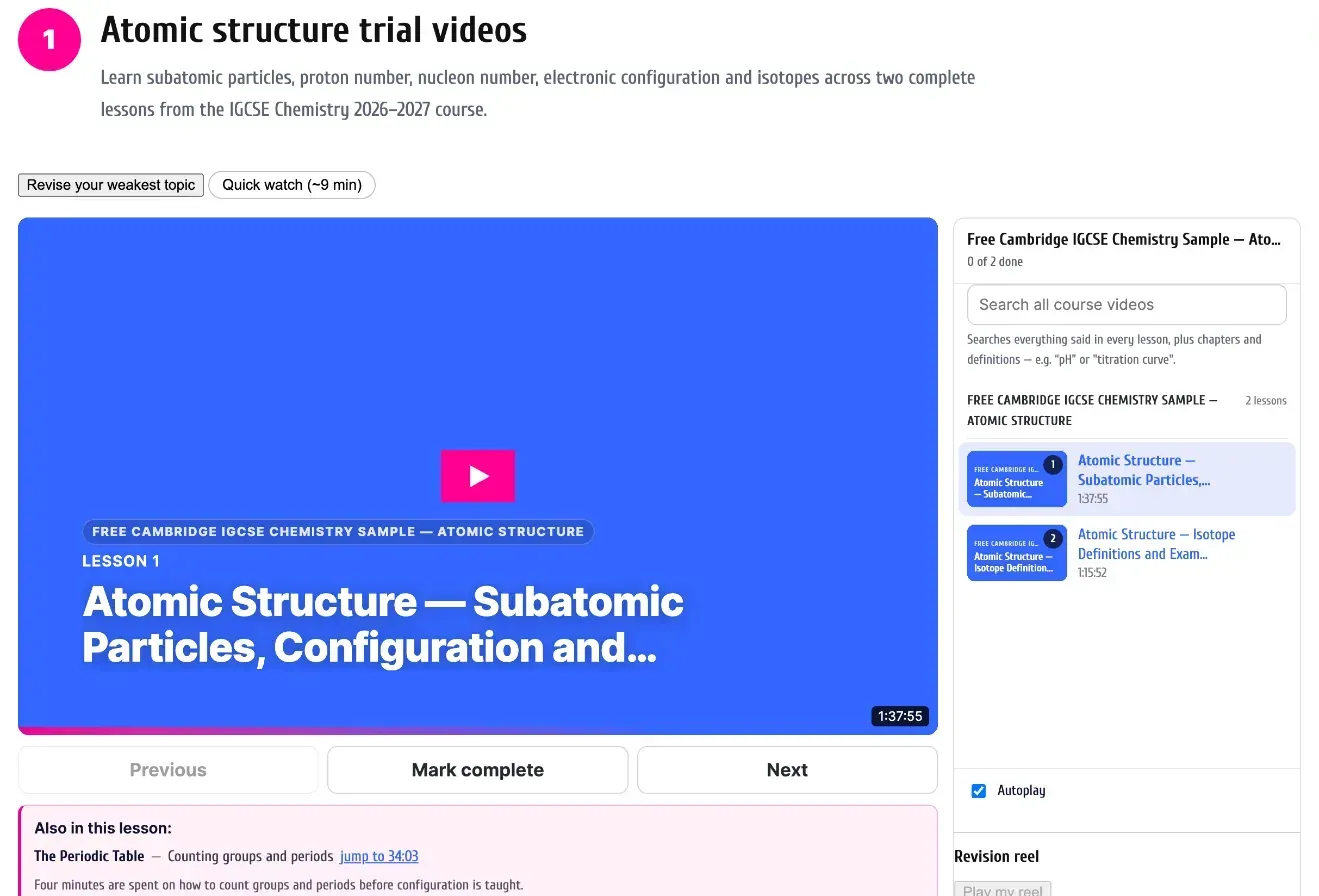
Lesson 1 of the free sample: a 1 h 38 min teaching video with chapter jump links, and a second video that solves the exam questions on the same topic.
Both routes finish the content by January for a reason I will be blunt about: a Chemistry topic learned in the last week of January has not been tested by you under exam conditions yet, and Paper 4 will test it on 5 February.
Where Chemistry students lose the marks that cost the A*
The marks that separate an A from an A* in my classes are lost in two places, moles and organic chemistry, and in both cases the student usually knows the chemistry and cannot show it in the form the mark scheme wants.
Organic chemistry: drawing the molecule. More students lose marks in the organic section than in any other, and the specific problem is drawing structures. When a question asks for the displayed formula of an ester, or the product of an addition reaction, the mark scheme answer is written as text, and it is often vague about what the drawing should look like. Students read that text and still cannot picture the structure the mark scheme is expecting, so they draw something chemically reasonable that does not match. The fix is to practise from the drawing side: for every organic reaction in topic 11, draw the full displayed formula of every reactant and product, every bond shown, until you can produce the drawing from the name without thinking. My IGCSE Biology and Chemistry notes eBook draws every one of these structures out in full for the 2026–2028 syllabus, which is what students tell me they were missing when they revised from text alone.
Moles: the working, especially in multiple choice. The second place is stoichiometry, and the issue is not the formula triangle. It is the working out. A Paper 2 question gives four numerical options and students pick one without being able to reconstruct how it was reached, so they cannot tell a correct answer from a distractor built on the same numbers. In Paper 4 the same gap shows up as a right method with a wrong unit, or a mole ratio read the wrong way round. The cure is to write the working for every mole question, including multiple choice, until the steps are automatic: moles of the known, ratio from the equation, moles of the unknown, convert. Students who do this for three weeks stop losing these marks.
Everything else is smaller. Electrolysis products at each electrode, the conditions for industrial processes and the Periodic Table trends cost a mark or two each, and they respond to ordinary revision. Moles and organic drawings are the two that cost the grade.
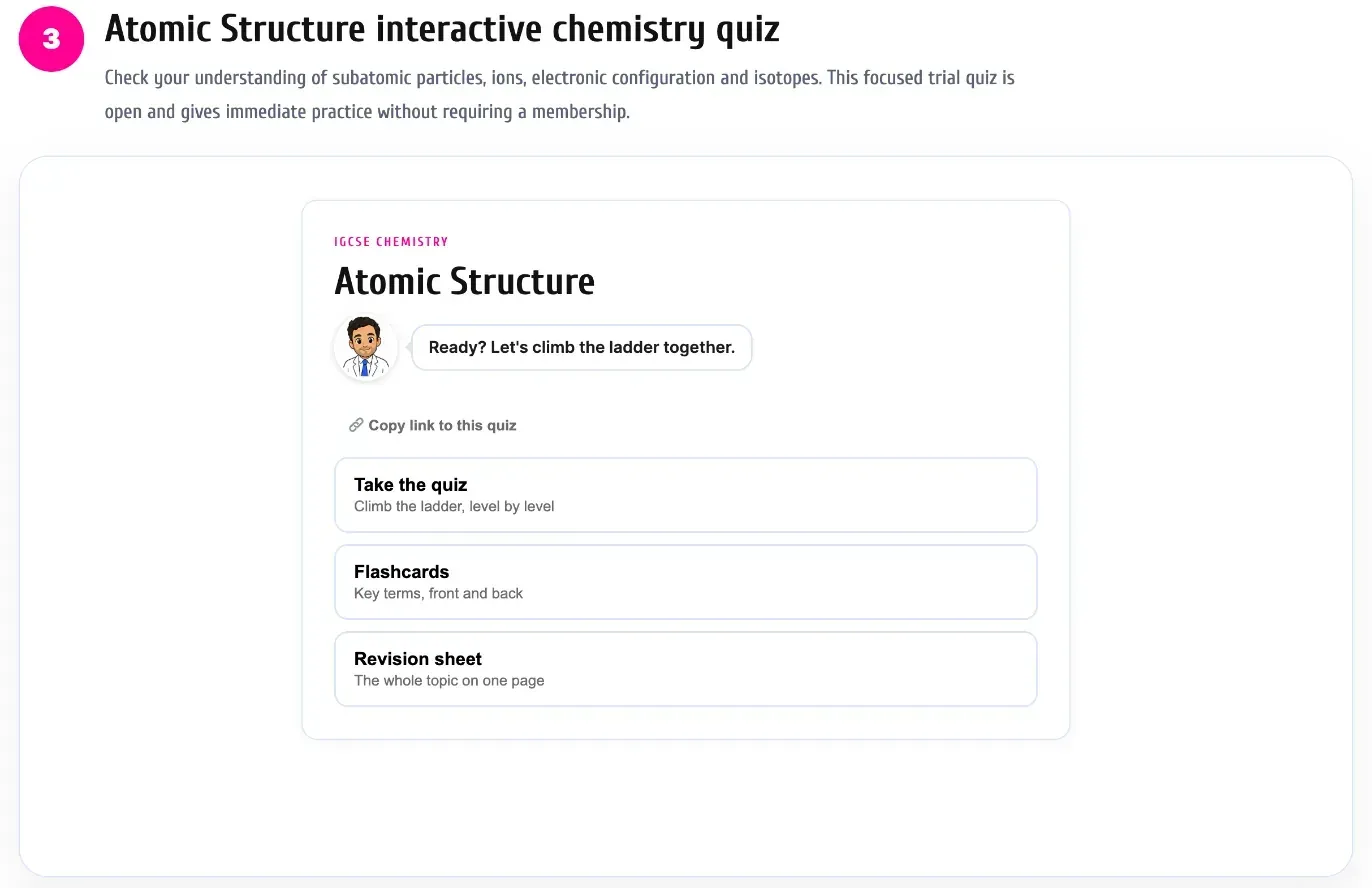
Each topic ends with a quiz ladder, flashcards and a revision sheet: the check that the terms and the calculations stuck before you move to past papers.
Paper 6: the 40 marks you can bank before February
Paper 6 tests experimental skills in fixed contexts, which is why it is the paper you can bring to 35 out of 40 before the series starts. The syllabus lists those contexts: rates of reaction, salt preparation, separation techniques, electrolysis, identification of ions and gases, titrations and displacement reactions, assessed through planning, recording observations, interpreting data and suggesting improvements. There is no new chemistry in it. There is a set of skills, and skills are learned slowly, so this is the paper to start in October.
The ions and gases question deserves its own paragraph because the rules changed. In my experience it is usually question 3 on Paper 6, and under the current syllabus the tests are no longer something you memorise for this paper: the syllabus states that "notes for use in qualitative analysis are provided for both Paper 5 and Paper 6", so the table of anion tests, cation tests with sodium hydroxide and ammonia, gas tests and flame colours is printed in the paper. That sounds like a gift. It is a trap for the unprepared, because the data sheet is long, the exam is one hour, and you have to find the right row fast.
What I recommend instead of memorising is mastering the keywords, so that the question itself tells you where to look. When you see barium ions in the reagent, the test is for sulfate. When you see silver nitrate, the test is for a halide, and the colour of the precipitate tells you which one: white for chloride, cream for bromide, yellow for iodide. Aqueous sodium hydroxide added in excess separates the white precipitates: aluminium and zinc dissolve, calcium does not. A gas that relights a glowing splint is oxygen; one that pops is hydrogen; one that bleaches damp litmus is chlorine. A student who has those keywords in their head reads the question, goes straight to the row, and answers in thirty seconds. A student who has not reads the whole sheet twice.
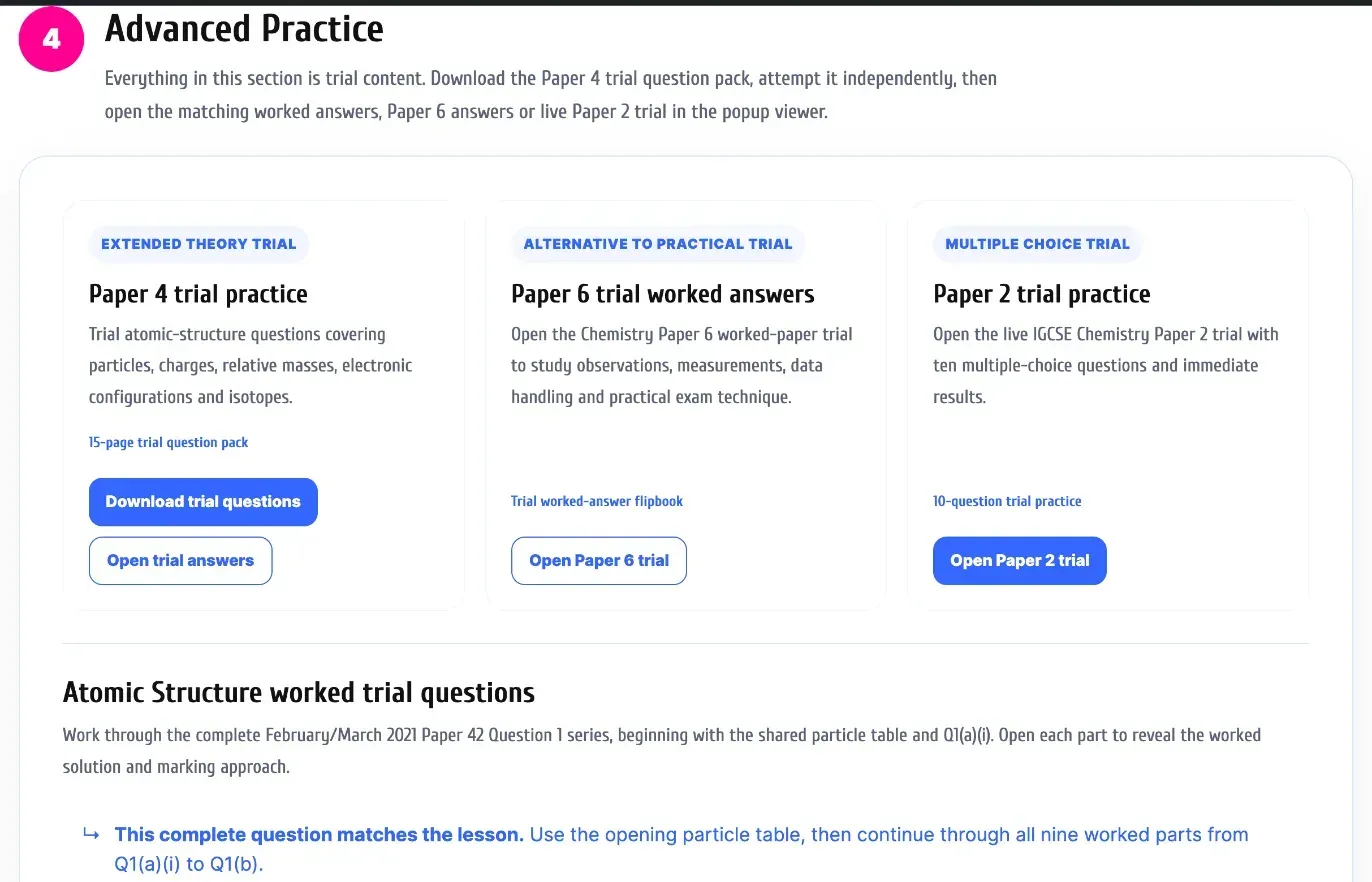
The trial Paper 6 pack covers observations, measurements, data handling and practical technique; the worked question beneath it is Question 1 from the February/March 2021 Paper 42, a March paper solved in full.
The rest of the paper rewards habits rather than knowledge: a results table with units in the headings and every reading to the same precision, a graph that uses more than half the grid with a best-fit line rather than dot-to-dot, a titration result quoted to the nearest 0.05 cm³, and an "improvement" answer that names a specific source of error rather than saying "repeat the experiment". The Paper 6 solved papers in my solved past papers bundle show each of these written for the marks, with the mark scheme alongside.
The order of work from now to 5 February
Work in this order: finish the twelve topics by mid-January using the two-session loop, start one Paper 6 skill a week now, switch to topic-classified Paper 4 questions in December, and sit full timed papers in the last three weeks. It is a sequence rather than a calendar because Chemistry's dates are compressed at the front of the series, and the sequence is what protects the theory paper.
- October to mid-January: content, one topic a week, solved the next day. Teach or watch the topic, then solve Paper 4 and Paper 6 questions on it the following day while practising Paper 2 questions with full working. Moles and organic chemistry get a second pass each; they are the two topics that decide the grade.
- October onwards, in parallel: one Paper 6 skill a week. Tables in October, graphs in November, the qualitative analysis keywords in December, titration and rates calculations in January. By the time Paper 6 sits on 9 February you will have handled every context in the syllabus at least twice.
- December: topic-classified Paper 4 questions. Every mole question back to back, then every organic question, then every electrolysis question, so that the pattern of what Cambridge asks becomes obvious. Mark against the mark scheme and write down the reason for every lost mark.
- Mid-January to 4 February: full timed papers, scored and weighted. Solve all the papers you can, and definitely all the papers from 2023 onwards, June and November included, since the March papers from your own series stay unreleased until after results. Convert each score to weighted marks and track the total against 175.
- 9 February to 3 March: Paper 2 only. After Paper 6, the three and a half weeks before the multiple-choice paper are for MCQ sets with written working, a set every other day, and nothing else. This is the stretch where March-series students get complacent and throw away 1.5 weighted marks at a time.
Start with the free Cambridge IGCSE Chemistry sample lesson if you want to test the loop before committing to it: two full lesson videos on atomic structure, the trial notes, a ten-question quiz, a Paper 4 question pack and a worked Paper 6 trial, with no sign-in. Last June, 68.5% of my IGCSE Chemistry students finished with an A or A*, and the ones who did best were the ones who had their Paper 6 habits and their mole working in place before the final month.
If you are not sure whether Core or Extended is the right entry, or whether fifteen weeks is enough from where your child is now, message me on WhatsApp at +965 5137 5709 or email admin@chem-bio.info with the target grade and the school's exam series, and I will reply personally.
FAQ
Is 8 in IGCSE an A or an A*? Cambridge IGCSE Chemistry 0620 is graded A* to G, so a student entered for 0620 receives a letter, not a number. The 9 to 1 scale belongs to the separate syllabus code 0971, which some schools enter instead; the papers are the same, only the reporting scale differs.
Is it hard to get an A* in IGCSE Chemistry? It needed 86% to 88.5% of the weighted marks in the last two March series, so it is demanding but predictable. In my classes the students who miss it almost always lose the marks on organic drawings and mole working rather than on unfamiliar chemistry.
What is the hardest topic in IGCSE Chemistry? In my experience it is stoichiometry, followed closely by organic chemistry, because both require a method to be shown rather than a fact to be recalled. Neither is hard once the working is practised in writing for every question, including multiple choice.
Can you sit the IGCSE February/March series outside India? No. The 0620 syllabus states that the March series is available in India only; candidates elsewhere sit June or November. The content, papers and grading standard are the same in all three series.
Try a free Class


