
Edexcel IAL Biology Unit 4 — Energy, Environment, Microbiology and Immunity
Unit 4 (WBI14/01) is the first A2 paper: photosynthesis and energy flow, climate change and evolution, then microbes, immunity and forensics. 90 marks in 1 h 45, examined in January, June and October, and it can include synoptic questions from Units 1 and 2.
Solved Unit 4 past papers See the A2 courseRevise Unit 4 with Mr Hosni
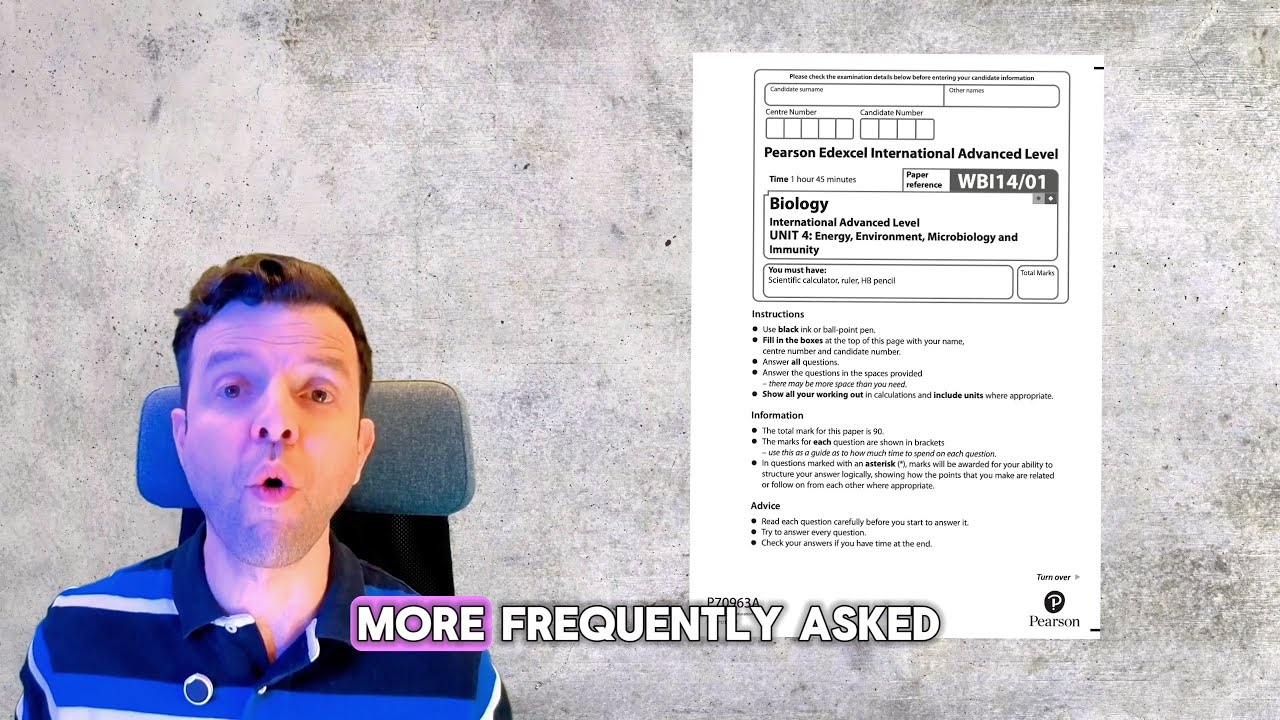
Ten topics that carry the paper, in under two minutes — then check the marks data below.
 Solving the most frequently asked Unit 4 questions (Jan 2026)
88-min live session
Solving the most frequently asked Unit 4 questions (Jan 2026)
88-min live session
 Every IAL Biology past paper has a question about this
Predicted for 2026
Every IAL Biology past paper has a question about this
Predicted for 2026
 This practical appears in nearly all Unit 3 and Unit 6 exams
Links to Unit 6
This practical appears in nearly all Unit 3 and Unit 6 exams
Links to Unit 6
What the WBI14 paper actually tests
I classified every question part from 17 papers, 2020 to March 2026 — 604 parts, 1,271 marks. Four topics carry about 60% of the marks: global warming (16%), microbiology (16%), ecology — sampling and succession (15%) and active immunity (14%). Photosynthesis light-dependent reactions add another 11%. Evolution, DNA profiling, the Calvin cycle and forensics are each 4–5%.
The command word tells you more than the topic. "Explain" leads with 28% of parts, then "Identify" (the multiple-choice items, 21%), "Describe" (11%), "Calculate" (10%) and "Suggest" (8%). "Suggest" is where Unit 4 separates the A from the B: an unfamiliar context, and you have to apply the biology rather than recall it. Twenty-eight percent of parts are high-difficulty. Revise the top four topics first, then practise every "Suggest" question in the solved papers until the reasoning pattern is automatic.
Share of marks by topic
17 papers · 604 question parts · 1271 classified marks · 2020–2026
Least examined
Command words, most to least common
Explain (171), Identify (129), Describe (67), Calculate (62), Suggest (49), State (31).
What this means for you
Global warming, Microbiology and Ecology: sampling & succession carry 47% of the marks. Revise them first, then work down the list. Every solved question below is written in the mark-scheme words the examiner ticks.
Topic 5: Energy flow, ecosystems and the environment
Photosynthesis is taught as two linked stages. The light-dependent reactions split water, make ATP by photophosphorylation and reduce NADP; the light-independent reactions fix carbon dioxide in the Calvin cycle with RUBISCO. You need chloroplast structure, absorption and action spectra, and chromatography with Rf values — CP 10 measures the rate against light, wavelength, temperature and CO₂.
Ecology moves from GPP and NPP through trophic efficiency to the abiotic and biotic factors that set a niche. CP 11, the habitat study with quadrats and transects, is the most examined practical in the whole A2. Succession is a short topic that appears almost every series.
Climate change is examined on evidence — CO₂ records, pollen in peat, dendrochronology — and on models, including why extrapolation has limits. The Q10 rule and the effect of temperature on development (CP 12) sit here. Evolution is covered as a change in allele frequency through mutation and selection, with allopatric and sympatric speciation. Finish with the reasons conclusions on controversial issues depend on who reaches them, and the case for reforestation, sustainable resources and biofuels.
Topic 6: Microbiology, immunity and forensics
Start with aseptic technique and the four ways to measure microbial growth, then the growth curve and the exponential growth-rate constant — a calculation that appears every year. CP 13 measures growth in liquid culture; CP 14 compares antibiotics.
Pathogens are handled by example: Ebola, TMV, HIV and phage λ for viruses, Mycobacterium tuberculosis for bacteria. Immunity is the largest single mark-earner in Topic 6: the non-specific barriers, phagocytosis and inflammation, then antigens, B and T cells, antibodies and the four types of immunity. Learn the evolutionary race between host and pathogen, bacteriostatic versus bactericidal antibiotics, and hospital-acquired infection codes of practice.
Forensics closes the unit: PCR, gel electrophoresis and DNA profiling, then time of death from decomposition, insect succession, body temperature and rigor.
How to revise Unit 4 in the right order
- Global warming, microbiology, ecology, immunity — the four 14–16% topics.
- Photosynthesis light-dependent reactions.
- Every "Suggest" and "Explain" question in the solved papers, marked against the model answers.
- The five core practicals as methods: variables, control, measurement, calculation, two errors.
- Everything else in a single pass with the checklist below.
Unit 4 specification checklist
Topics 5 and 6, condensed point by point. Tick as you master each — progress is saved on this device.
Topic 5 — Energy Flow, Ecosystems and the Environment
- 5.1–5.2 Photosynthesis as light-powered splitting of water; ATP from photophosphorylation and its hydrolysis as an immediate energy source
- 5.3 Light-dependent reactions: excited chlorophyll electrons, ATP, reduced NADP, cyclic and non-cyclic photophosphorylation, photolysis
- 5.4 Light-independent reactions: carbon fixation in the Calvin cycle — GP, GALP, RuBP, RUBISCO — and what plants build from the sugars
- 5.5–5.7 Chloroplast structure; absorption vs action spectra; separating pigments by chromatography and identifying them by Rf
- 5.8 CORE PRACTICAL 10 — effect of light intensity, wavelength, temperature and CO₂ on photosynthesis rate in an aquatic plant
- 5.9–5.10 GPP, NPP and plant respiration; calculating NPP; efficiency of biomass and energy transfer between trophic levels
- 5.11–5.13 Population, community, habitat, ecosystem; biotic and abiotic factors; how niche explains distribution and abundance
- 5.14 CORE PRACTICAL 11 — ecology of a habitat with quadrats, transects and abiotic measurements
- 5.15 Succession from colonisation to climax community
- 5.16–5.19 Evidence for climate change (CO₂ records, temperature, peat-bog pollen, dendrochronology); greenhouse effect; applying the carbon cycle; extrapolation and model limitations
- 5.20–5.21 Effects of climate change on species distribution, development and life cycles; temperature and enzyme rate, Q10
- 5.22 CORE PRACTICAL 12 — effect of temperature on development (seedling growth or brine-shrimp hatching), ethically
- 5.23–5.24 Evolution as change in allele frequency via mutation and selection; isolation, allopatric and sympatric speciation
- 5.25–5.26 Why conclusions on controversial issues depend on who reaches them; reforestation, sustainable resources and biofuels
Topic 6 — Microbiology, Immunity and Forensics
- 6.1–6.3 Aseptic culturing; measuring microbial growth (cell counts, dilution plating, mass, turbidity); growth-curve phases and exponential growth-rate constants
- 6.4 CORE PRACTICAL 13 — rate of growth of microorganisms in liquid culture
- 6.5–6.6 Bacteria vs viruses (Ebola, TMV, HIV, λ phage); lytic and latent; how M. tuberculosis and HIV infect cells and cause symptoms
- 6.7–6.8 Routes of entry and barriers (skin, stomach acid, flora); non-specific responses — inflammation, lysozyme, interferon, phagocytosis
- 6.9–6.11 Antigens, antibodies, plasma cells, macrophages, antigen-presenting cells; B and T cell roles; natural, artificial, active and passive immunity
- 6.12–6.13 The evolutionary race between pathogens and hosts; bacteriostatic vs bactericidal antibiotics
- 6.14 CORE PRACTICAL 14 — effect of different antibiotics on bacteria
- 6.15–6.16 Hospital-acquired infections and codes of practice; microorganisms in decomposition and carbon recycling
- 6.17–6.20 PCR, gel electrophoresis, DNA profiling; determining time of death — decomposition, succession, forensic entomology, body temperature, rigor
Condensed from the Pearson Edexcel International Advanced Level in Biology specification, Issue 2 (2018 qualification, units WBI11–WBI16). Always check the full wording in the official specification. For every topic from Unit 1 to Unit 6 in one tracker, use the Edexcel A Level (IAL) Biology specification checklist.
Unit 4 — FAQ
Is IAL Biology Unit 4 harder than Units 1 and 2?
It is longer (90 marks, 1 h 45 rather than 80 marks, 1 h 30) and it can include synoptic questions drawing on Units 1 and 2. Across 2020–2026 papers, Explain questions outnumber every other command word, so answers must be in mark-scheme language rather than general description.
Which Unit 4 topics carry the most marks?
Global warming, microbiology, ecology (sampling and succession) and active immunity each carry 14–16% of the marks across 2020–2026 papers; together they are about 60% of the paper.
How much maths is in WBI14?
At least 9 of the 90 marks target Level 2 mathematics: NPP and efficiency calculations, exponential growth rate constants, sampling statistics and index calculations.
When can I sit Unit 4?
January, June and October every year. Any unit can be resat; only the better of the two most recent attempts counts.
About this page
About Edexcel IAL Biology Unit 4 (WBI14/01). Unit 4, Energy, Environment, Microbiology and Immunity, is one of the three IA2 units of the Pearson Edexcel International Advanced Level in Biology (YBI11), examined in January, June and October. It is a 90-mark, 1 h 45 written paper worth 20% of the full IAL. The topic checklist on this page is a condensed study companion to the official specification (Issue 2); the marks analysis is Chem Bio's classification of every question part in 17 WBI14 papers from 2020 to 2026 (604 parts, 1271 marks) by topic, command word and difficulty. Written by Hosni Showike, Head of Science, 21 years teaching Edexcel IAL Biology.
Continue with
Every WBI14 question since 2020, solved for the marks
Point-by-point model answers in mark-scheme language, the notes written on this specification, and WhatsApp support from Mr Hosni until exam day.
Get the solved papers Join live IAL classesLast updated 2 September 2026
