
IGCSE Chemistry Paper 6 (Alternative to Practical): What Is on It and How to Score 35 Out of 40
One hour, 40 marks, 20% of the grade. Here is the paper question by question, what a grade A needs, and the habits that bank the marks.

TL;DR: IGCSE Chemistry Paper 6 is a one-hour, 40-mark written paper worth 20% of the grade that tests practical skills without a laboratory: reading apparatus, recording results, plotting graphs, identifying ions and gases from observations, and planning an investigation. Cambridge's specimen paper splits those marks as rates 7, titration 18, qualitative analysis 9 and planning 6. A grade A on the paper has needed between 27 and 31 out of 40 in every series since March 2023, and 35 is the mark I set my A* students. The tests for ions and gases are printed inside the paper, so the skill is finding the right row fast, and the marks students lose most are on the planning question at the end. Students in India sit Paper 6 on Tuesday 9 February 2027; everyone else sits the same paper in June or November.
On this page
- What is IGCSE Chemistry Paper 6?
- What questions are on Paper 6, and how many marks is each worth?
- How many marks do you need on Paper 6 for a grade A?
- Question 1: the apparatus marks nobody should drop
- Question 2: titration, temperature changes and rates
- Question 3: the ion and gas tests are printed in the paper
- Question 4: the planning question, and a plan that scored 2 out of 6
- The data rules Cambridge marks against
- When is Paper 6, and is the March series different?
- How to prepare for Paper 6 from now
- FAQ
What is IGCSE Chemistry Paper 6?
IGCSE Chemistry Paper 6, the Alternative to Practical, is a written paper of 1 hour and 40 marks that carries 20% of the Cambridge IGCSE Chemistry grade and tests experimental skills without any experiment being carried out. The Cambridge IGCSE Chemistry 0620 syllabus for 2026, 2027 and 2028 states that candidates "will not be required to do experiments as part of this test", that every question is compulsory, and that the paper assesses only AO3, the experimental skills objective.
Your school enters you for either Paper 5, a 1 hour 15 minute practical test in a laboratory, or Paper 6. Both are worth 40 marks and 20%, and the syllabus says they "require the same experimental skills" and "the same experimental contexts". The difference is that Paper 6 hands you the observations, readings and diagrams on paper and asks what a competent experimenter would do with them. The same paper is sat by 0620 and 0971 candidates; only the grade scale differs.
Because the paper tests skills rather than content, it is the one paper in IGCSE Chemistry where a well-prepared student can walk in knowing the shape of almost every question. That is the point of this post.
What questions are on Paper 6, and how many marks is each worth?
Paper 6 has four structured questions, and Cambridge's own specimen paper allocates them as rates of reaction 7 marks, acid–base titration 18 marks, qualitative analysis of two unknown solids 9 marks, and planning an investigation 6 marks. Those figures come from the Cambridge specimen Paper 6 for examination from 2023, which is the paper Cambridge published to show the format used from 2023 onwards, and the table below maps it question by question against what I see in the live papers I solve with my students every series.
| Question | Specimen context | Marks | Skills tested | What usually appears in live papers |
|---|---|---|---|---|
| 1 | Rate of reaction: magnesium and dilute hydrochloric acid, gas collected | 7 | Name apparatus from a diagram, describe a gas test, read a volume–time graph, sketch a predicted curve | Labelling apparatus, where to apply heat, chromatography, titration set-up, salt preparation and crystallisation |
| 2 | Acid–base titration: dilute hydrochloric acid against two sodium hydroxide solutions | 18 | Read burettes from diagrams, complete a results table, compare concentrations, explain technique, suggest improvements, plan a check | Titration, temperature changes (energetics), rates of reaction: recording data, plotting graphs, drawing smooth curves or best-fit lines |
| 3 | Qualitative analysis: two unknown solids tested with named reagents | 9 | Give observations, describe a flame test, identify the ions from the results | Identification of ions and gases using the data sheet printed in the paper |
| 4 | Planning: show that an orange drink contains no artificial colours | 6 | Design a method, name the apparatus, state what is compared and how a conclusion is drawn | Comparing temperature changes (which fuel releases more energy), percentage by mass of a substance in a sample, preparation of salts |
Question structure and marks from the Cambridge 2023 specimen Paper 6; the final column is my observation from recent series, not a Cambridge statement.
Two things in that table decide your revision. First, the titration question is worth 18 of the 40 marks, nearly half the paper, and most of its parts are one-mark readings and explanations that a drilled student answers in seconds. Second, the planning question is worth only 6 marks, yet it is where my students lose more marks than anywhere else on the paper. The rest of this post works through the paper in that order: secure the 34, then learn to write the 6.
How many marks do you need on Paper 6 for a grade A?
A grade A on Paper 6 has needed between 27 and 31 marks out of 40 in every series since 2023, so the target I set for an A* student is 35. Cambridge does not award A* at the level of a single paper, but it does publish the grade A threshold for each component, and the Paper 62 line was 27 in March 2023, 27 in March 2024, 30 in March 2025 and 28 in March 2026, according to the Cambridge grade threshold tables for March 2023, March 2024, March 2025 and March 2026. In the June series the line sat a little higher: 31 out of 40 on Paper 62 in both June 2025 and June 2026.
So a grade A is 70% to 78% of this paper. An A* at syllabus level needs about 86% to 88% of the weighted total, which is why I tell students that 35 out of 40 is the number to train towards, not 28. Every Paper 6 mark is worth exactly one weighted mark in the 200-mark total, so there is no multiplier to help you here; what you score is what you get. If you want the whole-grade picture, my IGCSE Chemistry grade boundaries guide tabulates the June and November series paper by paper.
The useful reading of those thresholds is this: Paper 6 is the paper on which a grade A line of 27 and an A* target of 35 are only eight marks apart, and those eight marks are concentrated in two places, the graph and the plan.
Question 1: the apparatus marks nobody should drop
Question 1 opens the paper with the easiest marks on it: identifying and labelling apparatus from a diagram, stating a gas test, and reading a result off a graph. In the specimen, the two apparatus marks are for naming a conical flask and a measuring cylinder, and the gas test is "lighted splint" and "squeaky pop", one mark each, as the specimen mark scheme sets out.
The apparatus that comes up most often in my experience is the conical flask, the filter funnel and the gas syringe. Learn to recognise each from a line drawing, not a photograph, because that is how the paper presents them. Pay attention as well to questions that ask where heat should be applied in a set-up: the mark is for an arrow pointing at the solid being heated, not at the water bath or the vessel collecting the gas.
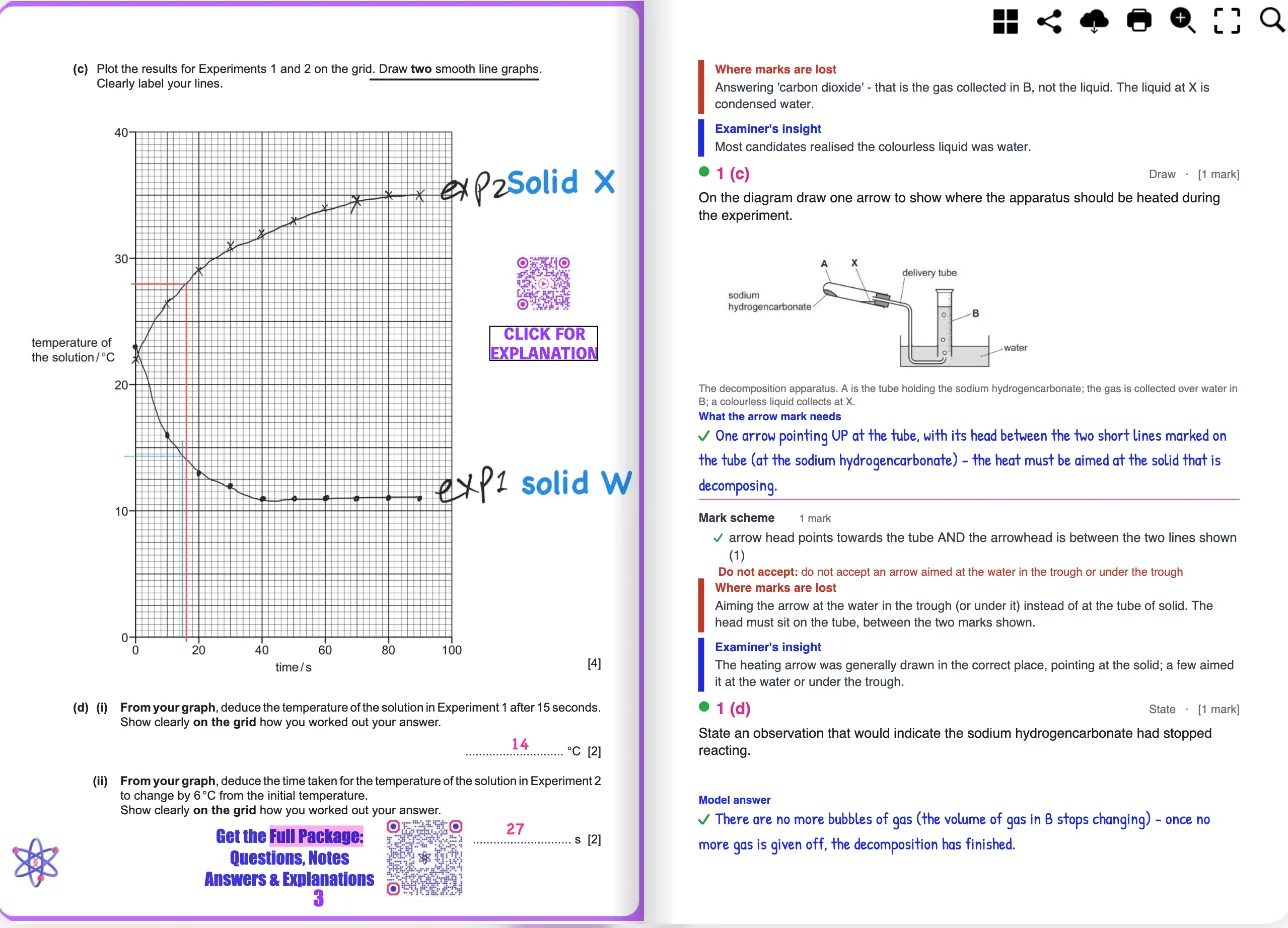
From my solved Paper 6 flipbook: a plotted graph with the readings taken off it, and the one-mark heating arrow with the mark scheme's "do not accept" beside it.
A few experiments turn up here again and again, so it is worth revising every small detail of them: chromatography (pencil baseline, solvent below the line, measuring spot heights), titration set-up (burette, pipette, indicator) and the preparation of salts, especially crystallisation (heat to the point of crystallisation, cool, filter, dry between filter papers). Each of those details is a one-mark line in a mark scheme somewhere.
Question 2: titration, temperature changes and rates
Question 2 is usually built on one of three experiments, titration, temperature changes in energetics, or rates of reaction, and it is the question where recording, plotting and reading data earn most of the marks. In the specimen it is an 18-mark titration, and the first four marks are for reading two burettes from diagrams, completing the results table and giving every volume to one decimal place, with the mark scheme crediting "all volumes to 1 d.p. or better".
That burette reading is the single habit that decides this question. A burette scale runs downwards: 0 is at the top and the numbers increase towards the tap, the opposite of a measuring cylinder. If a student realises that and reads the bottom of the meniscus to the nearest 0.05 cm³, the reading is always correct, and the titre (final reading minus initial reading) follows. This is one of the highest-scoring questions on the paper for students who have been taught that one fact, and one of the most expensive for students who read the burette as if it were a measuring cylinder.
The rest of the marks follow the pattern of a good lab notebook. The indicator colour change at the end point: name the indicator the question gives you and state its own change, in the right direction for what is being added to what. Why the flask is rinsed with distilled water between titrations (to remove what is left from the last experiment) and why it is not dried (the extra water does not change the number of moles of alkali). Whether warming the alkali changes the titre (it does not; temperature does not change the amount of sodium hydroxide present). How to make the result more reliable (repeat and compare) and more accurate (use a volumetric pipette or a burette rather than a measuring cylinder). Each of those is one mark, and each has a standard wording the mark scheme is looking for.
Although the question looks easy, I ask every student to pick a few recent past-paper questions on each of the three experiments and practise recording data, plotting the graph and drawing the smooth curve or best-fit line when one is asked for. These are marks nobody should be losing, and the aim is to answer them quickly and accurately so the time goes to the harder questions later. My solved Paper 6 past papers flipbook shows the graphs drawn and the readings taken off them, with the mark scheme next to each.
Question 3: the ion and gas tests are printed in the paper
The qualitative analysis question gives you the tests and the observations for two unknown substances and asks for the observations you would see or the ions present, and under the current syllabus you do not have to memorise the tests, because the syllabus states that "notes for use in qualitative analysis are provided for both Paper 5 and Paper 6". In the specimen they sit on pages 11 and 12 of the paper: tests for anions, tests for cations with aqueous sodium hydroxide and aqueous ammonia, tests for gases and flame colours.
That sheet is a gift only to the student who knows it well enough to find the right row in seconds. The exam is one hour, the sheet is two pages, and a student who reads it from the top for every part will run out of time on the last question. What I teach instead is keywords. When the question says barium ions or barium nitrate, the test is for sulfate. When it says silver nitrate, the test is for a halide, and the precipitate colour tells you which: white for chloride, cream for bromide, yellow for iodide. When it says aluminium foil and warming, the test is for nitrate, and the gas produced is ammonia. Sodium hydroxide added in excess separates the white precipitates: aluminium and zinc dissolve, calcium does not. A gas that relights a glowing splint is oxygen; one that pops is hydrogen; one that bleaches damp litmus is chlorine.
In the specimen, solid C gives a white precipitate in one test and, in another, a green precipitate that stays when the reagent is added in excess, which is the sheet's signature for iron(II) ions, and solid D is identified from a flame test and two further tests. The mark scheme awards two marks for naming calcium ions and chloride ions, and three for describing the flame test from any of: a clean wire or a splint soaked in the solution, a blue roaring flame, putting the wire into the flame, and observing the colour. Describing the procedure is a skill of its own, separate from reading the sheet, and it needs practising on paper.
Question 4: the planning question, and a plan that scored 2 out of 6
Question 4 asks you to plan an investigation, it is worth 6 marks, and it is the question my students lose the most marks on. Three types of investigation have appeared most often in recent series: comparing temperature changes (for example, which fuel releases more energy), determining the percentage by mass of a substance in a sample, and preparing a salt. The specimen's version asks for a chromatography plan to show that an orange drink contains neither of two named dyes, and the mark scheme lists seven creditable points (chromatography, a pencil baseline, spotting the drink and both dyes, solvent below the baseline, letting the solvent run, measuring the spot heights, comparing them) of which any six earn full marks.
Here is a plan I see from students every year. The question gives students crystals of a hydrated salt, tells them the colour changes on heating, and asks for the percentage of water by mass. A typical weak answer heats the crystals, weighs them at the end, and subtracts the final mass from the initial mass. It scores two marks, for the heating and the working, and loses the other four, because the student never crushed the crystals, never weighed the sample before heating, never heated until the colour change was complete even though the question handed them that clue, never repeated anything, and never named a single piece of apparatus.
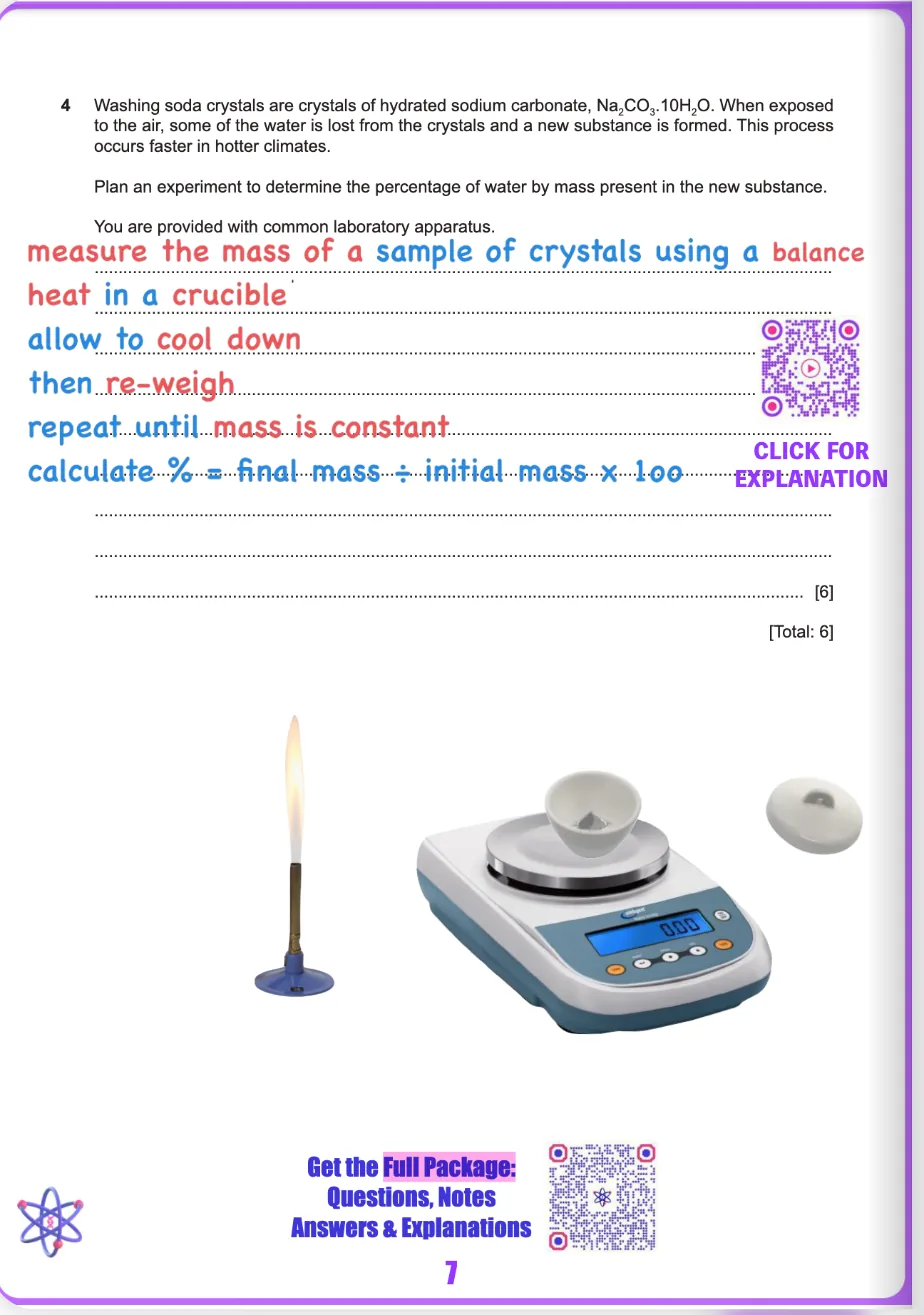
The hydrated-salt planning question, solved: weigh, heat in a crucible, cool, re-weigh, repeat to constant mass, then calculate. Six lines, six marks.
When you plan an investigation, these are the points I want you to check before you write a word:
- If you are given a solid, ask whether it needs crushing first to increase its surface area. If the answer is yes, say so, and name the pestle and mortar.
- Name the correct piece of equipment at every step. A balance to weigh, a crucible to heat, a measuring cylinder or pipette for a volume, a thermometer for a temperature. "Weigh the sample" without "using a balance" is a sentence, not a mark.
- Weigh before and after, and heat to constant mass. For a percentage-by-mass question the mark scheme wants the initial mass, the final mass, and the calculation: mass lost divided by the initial mass, times 100.
- If you are comparing two experiments, keep the relevant conditions the same. Same mass of fuel, same volume of water, same starting temperature, same distance from the flame. The fair-test mark is the one most often missed.
- Repeat the experiment, ideally five times where practical, and say what you will do with the repeats (average them, discard an anomalous result).
These are small details, but on a six-mark question they are the difference between 2 and 6, and between a grade A and an A* on the paper. I go through the three investigation types, and the planning tricks that earn the marks, in my video on how to reach 35 or more in IGCSE Chemistry Paper 6.
The data rules Cambridge marks against
Paper 6 marks tables, graphs and readings against a fixed set of rules, and they are written down in the syllabus, so there is no excuse for losing marks to them. The 0620 syllabus says to read instruments to half of the smallest scale division and record to the instrument's precision; to put units in table headings with a solidus (time / s), not in the body; to plot the independent variable on the x-axis with scales that spread the data across more than half the grid; to give calculated values the same number of significant figures as the least precise raw data; and to draw best-fit lines as single, thin, smooth lines, ignoring clearly anomalous points.
The mark scheme adds the rule that costs the most marks: "a missing or incorrect unit will normally mean that the final calculation mark is not awarded". A correct titre with no cm³ after it is a lost mark. The mark scheme also confirms that error carried forward applies, so a wrong burette reading used correctly in the subtraction still earns the subtraction mark, and that marks are never deducted; you can only fail to earn them. The habits that follow:
- Tables: units in the heading, every reading to the same number of decimal places, independent variable in the first column.
- Graphs: both axes labelled with quantity and unit, a scale that uses more than half the grid, points as crosses, one smooth line, construction lines drawn on the grid when you read a value off it.
- Readings: burette to 0.05 cm³, thermometer to 0.5 °C, and the number written the way the instrument shows it.
My IGCSE Biology and Chemistry notes eBook has these rules on one page, next to the tests for ions and gases, so they can be revised together.
When is Paper 6, and is the March series different?
Students in India sit Chemistry Paper 6 on Tuesday 9 February 2027 in the morning session, four days after Paper 4 on Friday 5 February, according to the Cambridge final timetable for the March 2027 series; the series runs from 3 February to 4 March with results on 13 May, as set out in the official Cambridge key dates for the March 2027 exam series. Students sitting in June or November take Paper 6 on the date their school's timetable gives, usually within the same fortnight as the theory paper.
The paper itself does not change between series. The syllabus states that exams are available in June and November and "also available in the March series in India", and the component thresholds above show the March and June papers held to the same standard: a grade A needed 28 out of 40 in March 2026 and 31 in June 2026, and 30 in March 2025 against 31 in June 2025. March is not an easier sitting. If you are one of the students sitting the whole series in February and March, my guide to how many marks an A* needs in IGCSE Chemistry in the March series has the dates for all three papers and the order of work from now to 5 February.
How to prepare for Paper 6 from now
Prepare for Paper 6 one skill a week from October, not one paper a day in the final fortnight, because the marks are for habits rather than facts and habits are learned slowly. The order I use with my own classes:
- Apparatus and set-ups. Draw and label the conical flask, filter funnel, gas syringe, burette, pipette and crucible from memory; then do five Question 1s from recent papers against the mark scheme.
- Burettes and tables. Read ten burette diagrams, write every reading to two decimal places ending in 0 or 5, build the titre table with units in the headings.
- Graphs. Plot five sets of results, draw the smooth curve or best-fit line, take readings off the graph with construction lines, and check each against the mark scheme.
- The data sheet. Learn the keywords, then time yourself: a full Question 3 in under eight minutes.
- Planning. Write a six-line plan for each of the three investigation types (temperature change, percentage by mass, salt preparation) and mark it against the five points above.
- Full papers under time. From December, one Paper 6 a week in one hour, scored, with every lost mark written down next to the rule it broke. Solve all the papers from 2023 onwards.
The Paper 6 trial pack in my free sample lesson is the place to start: a worked Paper 6 with observations, measurements, data handling and practical technique, open without a sign-in.
The Paper 6 trial worked answers sit in the free sample next to the Paper 4 and Paper 2 packs.
Students in my IGCSE Chemistry course get the full set of solved Paper 6 papers with the mark scheme beside every answer, and the solved past papers bundle has the same papers for students who only want the practice. If you are not sure which paper your school has entered you for, or whether your child is on track for 35, message me on WhatsApp at +965 5137 5709 or email admin@chem-bio.info and I will reply personally.
FAQ
Is Paper 6 easier than Paper 5? Neither is designed to be easier: the syllabus says both papers test the same AO3 skills in the same experimental contexts and both are worth 40 marks and 20%. Paper 6 removes the laboratory, so the marks depend entirely on how well you handle readings, tables, graphs and plans on paper.
Do I have to memorise the tests for ions and gases for Paper 6? No. The syllabus states that the notes for use in qualitative analysis are provided for both Paper 5 and Paper 6, so the table of tests is printed in the paper; what you need is to know the keywords well enough to find the right row quickly.
What apparatus do I need to know for Paper 6? The syllabus lists common school laboratory apparatus, and the pieces that appear most often in the paper are the conical flask, filter funnel, gas syringe, burette, pipette, measuring cylinder, thermometer, balance and crucible. You must recognise each from a line drawing and name it exactly.
How long should I spend on each question in Paper 6? The paper is 60 minutes for 40 marks, which is 1.5 minutes per mark, so a 7-mark question deserves about ten minutes and the 18-mark titration about 27. Keep the final ten minutes for the planning question and a check of every unit and decimal place.
Try a free Class


