
Edexcel IGCSE Chemistry Specification (4CH1) Checklist
The Edexcel IGCSE Chemistry (4CH1) specification has four content sections examined in two papers (Paper 1 and Paper 2, 180 marks in total). This page lists every learning objective as a checklist you can tick off.
The complete Edexcel IGCSE Chemistry (4CH1) specification — often called the syllabus — reorganised as an interactive revision checklist. Tick off each learning objective as you master it: your progress is saved on this device, so you can come back any time. Content assessed only on Paper 2 is clearly flagged.

How the two Edexcel IGCSE Chemistry papers cover the syllabus
Paper 1 (4CH1/1C) is a 2-hour exam worth 110 marks — 61.1% of your grade. It assesses the core content only: every statement below without a P2 badge.
Paper 2 (4CH1/2C) is 1 hour 15 minutes, worth 70 marks — 38.9% of your grade. It can assess everything , including the deeper 'C' statements badged P2 ONLY below. Both papers mix multiple-choice, short-answer, calculation and extended-response questions, and both are offered in June and November.
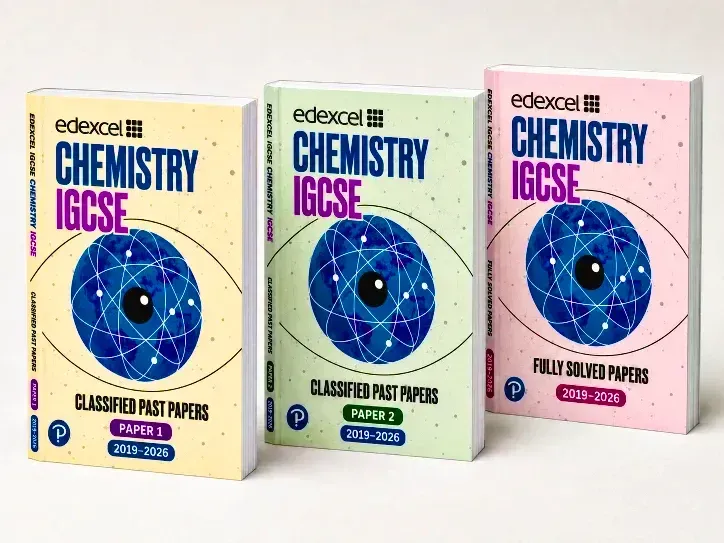
Ticked the topics — now practise them the way examiners mark them
Every Edexcel IGCSE Chemistry past paper from 2019–2026, fully solved and classified by these exact syllabus points, with every calculation worked line by line. The complete notes eBook is included free.
Get the Solved Past Papers → See the Chemistry Notes eBook⬇ Download the syllabus PDF (4CH1)
About the Edexcel IGCSE Chemistry (4CH1) specification — the official syllabus
The Pearson Edexcel International GCSE in Chemistry (specification code 4CH1) is assessed through two written papers, with grades from 9 to 1 and a combined total of 180 marks. The content is organised into four sections — Principles of Chemistry, Inorganic Chemistry, Physical Chemistry and Organic Chemistry — and every examinable idea is written as a numbered specification point, which is exactly what this checklist tracks. In everyday use, "specification" and "syllabus" mean the same thing here: the official list of everything Edexcel can examine in IGCSE Chemistry.
Core statements can be tested on either paper. Statements printed in bold with a 'C' reference in the official document (for example metallic bonding, electrolysis, titrations, bond energy calculations, alcohols, carboxylic acids and esters) are examined on Paper 2 only — that's what the P2 ONLY badge above means. Specified practicals are assessed through written questions, not coursework, so you need to know each method, its variables and how to evaluate the results.
Use this page as your master revision tracker: work through your Edexcel IGCSE Chemistry notes topic by topic, tick each point once you can answer questions on it, then confirm it with real exam questions from the Edexcel IGCSE Chemistry solved past papers (2019–2026). Sitting Cambridge instead? We also cover the Cambridge IGCSE Chemistry 0620 solved past papers.
Edexcel IGCSE Chemistry specification explained
The Edexcel IGCSE Chemistry specification is coded 4CH1, covers four topic areas, and is assessed by two written papers worth 180 marks in total. Paper 1 carries 110 marks and 61.1% of your grade; Paper 2 carries 70 marks and 38.9%, and it is the only paper that tests the bold "C" content. The content itself has not changed since first assessment in 2019 — what has changed is that Pearson now offers a modular version (4XCH1) alongside the linear one, and you cannot sit both. In seventeen years of teaching and examining this course, the modular split is the single decision I see schools make without explaining the consequences to families.
What is the Edexcel IGCSE Chemistry specification?
The Edexcel IGCSE Chemistry specification is Pearson's course code 4CH1 — a linear International GCSE first taught in September 2017 and first examined in June 2019, graded on the 9–1 scale with no tiers. Everything you sit comes at the end of the course, in one series.
"Linear" is the word that trips people up, so let me put it plainly: both papers must be taken in the same exam series, at the end of the two years. There is no half-way exam that banks a grade for you. Pearson's own International GCSE Chemistry specification document sets this out on its first page, and it is worth downloading once and keeping — it is the only version of the syllabus that counts on results day.
One more thing families often miss. This qualification is not regulated by a UK regulator such as Ofqual; it is an international qualification designed to sit at the same level of demand as the reformed UK GCSEs. That does not make it easier. If anything, the marking I see is tighter than most parents expect.
If you want the full point-by-point content laid out rather than summarised, the complete topic-by-topic checklist above lists every 4CH1 specification statement, organised the way I teach it.
Which topics are on the Edexcel IGCSE Chemistry syllabus?
The Edexcel IGCSE Chemistry syllabus is built from four topic areas: Principles of chemistry, Inorganic chemistry, Physical chemistry and Organic chemistry. Between them they hold roughly thirty sub-topics and around two hundred numbered specification statements.
Here is the shape of it:
- Principles of chemistry — states of matter; elements, compounds and mixtures; atomic structure; the Periodic Table; chemical formulae, equations and calculations; ionic bonding; covalent bonding; metallic bonding; electrolysis.
- Inorganic chemistry — Group 1 (alkali metals); Group 7 (halogens); gases in the atmosphere; the reactivity series; extraction and uses of metals; acids, alkalis and titrations; acids, bases and salt preparations; chemical tests.
- Physical chemistry — energetics; rates of reaction; reversible reactions and equilibria.
- Organic chemistry — introduction to organic compounds; crude oil; alkanes; alkenes; alcohols; carboxylic acids; esters; synthetic polymers.
Practical work is not a separate coursework component. Pearson embeds the required practicals inside the content as italicised statements — investigating paper chromatography, determining the formula of a metal oxide, preparing hydrated copper(II) sulfate crystals, and so on — and then tests them through written questions. Around a fifth of the total marks (19–21%) sit under the experimental-skills objective, which is a large slice to leave to chance.
Where do students struggle? In my classes this year, out of fourteen students, ten found mole calculations the hardest single area of the course — and by the end of the year, close to half of those ten had it under control. That is a topic you cannot cram in April. My Edexcel IGCSE Chemistry notes written against every 4CH1 specification point devote extra worked space to exactly that section, because it is where the marks quietly leak away.
How is Edexcel IGCSE Chemistry examined?
Two written papers, sat in the same series, for a combined 180 marks. Paper 1 is the long one at 110 marks and 61.1% of the qualification; Paper 2 is shorter at 70 marks and 38.9%, and it is the paper that reaches the bold content.
| Paper 1 | Paper 2 | |
|---|---|---|
| Paper code | 4CH1/1C (and 4SD0/1C) | 4CH1/2C |
| Duration | 2 hours | 1 hour 15 minutes |
| Marks | 110 | 70 |
| Weighting | 61.1% | 38.9% |
| Content assessed | Core content only — statements not in bold, without a "C" reference | All content, including bold "C" statements |
| Question styles | Multiple choice, short answer, calculations, extended open response | Multiple choice, short answer, calculations, extended open response |
| Calculator | Allowed | Allowed |
Figures from the Pearson Edexcel International GCSE in Chemistry (4CH1) specification, Issue 3.
Questions in either paper can come from any topic area. There is no "Paper 1 is physical, Paper 2 is organic" arrangement, however tempting that would be for revision planning.
Now the part I care about most, because it is where I watch marks disappear. Most marks are lost on Paper 1, not Paper 2 — and not because Paper 1 is difficult. It is the more straightforward paper, and that is precisely the trap. Students relax into it and answer casually, while the examiners marking it are strict about vocabulary in a way almost nobody expects.
A concrete example. Describe an ionic compound without the word lattice , and you will not get the mark, however sound your understanding is. Explain bonding without the phrase electrostatic attraction , and again, no mark. The mark scheme lists the words; the examiner looks for the words. Understanding chemistry and writing it in the language the mark scheme accepts are two different skills, and only one of them is examined.
That is the single strongest argument for working through Edexcel IGCSE Chemistry solved past papers with examiner-style model answers rather than only reading notes. You are training your phrasing, not just your chemistry.
What the bold "C" specification points mean
Bold specification statements carrying a "C" reference are Chemistry-only content — they appear in the separate IGCSE Chemistry course but not in the International GCSE in Science (Double Award), and they are examined on Paper 2 only.
This is the structural detail that catches students moving between courses, or revising from a friend's Double Award notes. Points such as solubility curves (1.5C–1.7C), metallic bonding (1.52C–1.54C), electrolysis in full (1.55C–1.60C), metal extraction (2.22C–2.27C), acid–alkali titrations (2.33C), bond energies (3.7C), dynamic equilibrium (3.19C–3.22C), alcohols, carboxylic acids and esters (4.29C–4.43C) and condensation polymers (4.48C–4.50C) all sit in this bold band.
Two of them account for a disproportionate share of the marks I see lost year after year: writing ionic half-equations for electrolysis, and the practical questions on titration. The half-equations fail on charge balance and on the oxidation-or-reduction label; the titration questions fail on procedural detail — the rinsing, the reading, the reason for the step. Neither is conceptually hard. Both are heavily patterned, which means both are trainable if you drill them against real papers rather than reading about them.
You can work through the free Edexcel IGCSE Chemistry past papers arranged by paper and series and pull out every electrolysis and titration question you find. Do that for a fortnight and Paper 2 stops being frightening.
Linear (4CH1) or modular (4XCH1)?
Pearson now offers a modular International GCSE in Chemistry, code 4XCH1, first taught from September 2024 with first assessment in June 2025, in which units are available in June and November and can be sat in any order or re-sat. You cannot enter for both — the modular International GCSE Chemistry specification and the linear one list each other as forbidden combinations.
Schools present modular as the gentler route: smaller chunks, earlier exams, a re-sit safety net. My advice, after teaching this course since 2017, runs the other way. I would take the linear route unless your school forces the modular one.
The reason is simple, and it is the thing the modular brochure will not tell you. Modular students still have to revise Unit 1 while preparing for Unit 2, because the second exam assumes the first unit's chemistry and asks about it. Splitting the course into two sittings does not halve the revision — it duplicates it, and it does so at the worst moment, when students have already mentally filed Unit 1 away as finished. I watch them sit down to a Unit 2 paper and stall on a bonding question they answered comfortably eight months earlier.
The linear route keeps one body of chemistry alive in one continuous stretch, and it is far more streamlined to teach and to revise. If your school offers a choice, that is where I would send you.
Is the specification changing for 2026 or 2027?
No — the content of the Edexcel IGCSE Chemistry specification has not changed since first assessment in 2019. The current document is Issue 3, published September 2024, and its listed amendments are administrative: exam availability updated to November and June, the modular qualifications added to the forbidden combinations list, and the command word "Which" added to the taxonomy.
This is the question parents send me most often, usually in a message that begins something like "Has the specification changed this year?" The honest answer is reassuring: apart from the arrival of the modular option, the chemistry your child is studying is the same chemistry I was teaching in 2019. Old past papers remain fully valid practice. Older textbooks are not out of date.
What does move is the marking — grade boundaries shift with each series, and examiner reports flag fresh patterns in how questions are answered. That is the layer worth watching, not the specification itself. I read every examiner report as it appears and fold what it says into my teaching, because that is where the year-on-year change lives.
If you are weighing up the linear and modular routes for your own school, or you want a second opinion on a subject choice, message me on WhatsApp at +965 5137 5709 or email [email protected]. I have taught around 140 Edexcel IGCSE Chemistry students since 2017, and the pattern in those conversations is remarkably consistent.
Edexcel IGCSE Chemistry specification — FAQ
Is the Edexcel IGCSE Chemistry specification the same as the syllabus?
Yes. Edexcel officially calls the document a "specification", but most students, parents and schools call it the syllabus. Both refer to the same thing: the complete list of topics and learning objectives examined in IGCSE Chemistry 4CH1 — exactly what this checklist covers.
What is the specification code for Edexcel IGCSE Chemistry?
The subject code is 4CH1. Paper 1 is 4CH1/1C and Paper 2 is 4CH1/2C. Exams are available in the June and November series.
What's the difference between Paper 1 and Paper 2 content?
Paper 1 (2 hours, 110 marks, 61.1%) tests core content only. Paper 2 (1 hour 15 minutes, 70 marks, 38.9%) can test all content, including the bold 'C' statements that cover certain sub-topics in greater depth — flagged P2 ONLY in this checklist.
Is there a practical exam in Edexcel IGCSE Chemistry?
No. Practical skills are assessed through written questions in both papers. The specification lists required practicals — such as chromatography, salt preparation and rate-of-reaction investigations — which are marked PRACTICAL in this checklist.
How do I use this checklist to revise?
Open a section, study the topic from your notes, then tick each specification point once you can answer exam questions on it without help. Your ticks are saved in your browser, and finishing a whole topic earns you some confetti. Finish the loop by practising real questions from the solved past papers.
How many topics are in the Edexcel IGCSE Chemistry specification?
Four sections: Principles of Chemistry (states of matter, atomic structure, bonding, calculations, electrolysis), Inorganic Chemistry (groups 1 and 7, reactivity, acids and salts, tests), Physical Chemistry (energetics, rates, equilibria) and Organic Chemistry (crude oil, alkanes, alkenes, alcohols, acids, esters, polymers).
Where can I download the Edexcel IGCSE Chemistry specification PDF?
Pearson hosts the official 4CH1 specification as a free PDF on its qualifications site, and it is the only version you should revise from. Third-party summaries are useful, but they are not the document the examiners work from.
What is the difference between IGCSE Chemistry and Science Double Award?
Double Award covers only the non-bold content, so the bold "C" statements — metallic bonding, full electrolysis, titrations, alcohols, esters and condensation polymers — are outside it. Separate Chemistry goes deeper and is the stronger preparation if you intend to take Chemistry at A level.
How many papers is Edexcel IGCSE Chemistry?
Two: Paper 1 (2 hours, 110 marks) and Paper 2 (1 hour 15 minutes, 70 marks), sat in the same series. Together they total 180 marks, and individual papers are not separately graded.
Can I use a calculator in the Edexcel IGCSE Chemistry exams?
Yes, a suitable electronic calculator is allowed in both papers. Calculators with QWERTY keyboards or that can retrieve stored text or formulae are not permitted.
See how to move from reading Chemistry notes to applying knowledge in exam questions. The video explains how exam-focused notes, mark-scheme language, flashcards and quizzes help you spot misconceptions and prepare for past-paper practice.
Turn this syllabus checklist into an A*
Notes written for the mark scheme and the latest syllabus, every past paper 2019–2026 solved line by line, a practice app, video explanations and direct WhatsApp support from Mr Hosni.
Get Full Access — Solved Past Papers Explore the IGCSE Chemistry Course

