IAL Chemistry Unit 1 (WCH11): What Comes Up Most — 20 Past Papers Analysed
Five topics carry about 54% of all WCH11 marks. Here is the full ranking, the January lean and the question types set in every paper.

TL;DR: Across 20 IAL Chemistry Unit 1 (WCH11) papers from June 2019 to January 2026, five topics carry about 54% of the 1,600 marks: moles and equations, alkenes, mass spectrometry, ionisation energy and shapes of molecules. Formulae, equations and amounts of substance is the only topic in all 20 papers, at about 13 marks each time. Four question types have appeared in every paper: ionisation energy, pV = nRT, polar bonds and dot-and-cross diagrams. Shapes of molecules has risen from about 5% of marks to about 13%, while alkenes has fallen from about 18% to about 5.5%. The full 21-topic table and a seven-step revision order are below.
On this page
- Which WCH11 topics carry the most marks?
- How the 20 papers were counted
- Which question types appear in every WCH11 paper?
- How has WCH11 changed since 2019?
- Are January WCH11 papers different?
- Small but certain, rare but huge
- Which definitions does WCH11 ask most?
- Where do students lose marks in WCH11?
- What to revise first for WCH11
- FAQ
Which WCH11 topics carry the most marks?
Formulae, equations and amounts of substance carries the most marks in IAL Chemistry Unit 1 (WCH11): about 16% of all marks, in 20 of 20 papers. The top five topics together hold about 54% of the 1,600 marks I counted, and adding combustion and fuels takes that to about 61%.
So more than half of the paper comes from five chapters. If your time before the exam is short, that is where it should go first.
| Rank | Topic | Marks out of 1,600 | Share of marks | Papers it appeared in | Average per paper | Most in one paper |
|---|---|---|---|---|---|---|
| 1 | Formulae, equations and amounts of substance | 260 | 16.2% | 20/20 | 13.0 | 29 |
| 2 | Alkenes and electrophilic addition | 216 | 13.5% | 16/20 | 10.8 | 36 |
| 3 | The mass spectrometer | 140 | 8.8% | 16/20 | 7.0 | 23 |
| 4 | Ionisation energy | 138 | 8.6% | 19/20 | 6.9 | 20 |
| 5 | Shapes of molecules | 115 | 7.2% | 12/20 | 5.8 | 16 |
| 6 | Combustion of hydrocarbons and fuels | 101 | 6.3% | 14/20 | 5.0 | 17 |
| 7 | Bond fission and free radicals | 88 | 5.5% | 17/20 | 4.4 | 15 |
| 8 | Ionic bonding | 71 | 4.4% | 14/20 | 3.5 | 22 |
| 9 | Periodicity | 60 | 3.8% | 14/20 | 3.0 | 17 |
| 10 | Structural isomers | 54 | 3.4% | 10/20 | 2.7 | 18 |
| 11 | Covalent bonding | 53 | 3.3% | 6/20 | 2.6 | 21 |
| 12 | Giant covalent structures | 42 | 2.6% | 9/20 | 2.1 | 20 |
| 13 | Electronic structure | 41 | 2.6% | 18/20 | 2.0 | 15 |
| 14 | Structure of the atom | 40 | 2.5% | 15/20 | 2.0 | 14 |
| 15 | Addition polymerisation | 36 | 2.2% | 8/20 | 1.8 | 13 |
| 16 | Geometric isomers (E/Z) | 33 | 2.1% | 12/20 | 1.6 | 12 |
| 17 | Fractional distillation and cracking | 29 | 1.8% | 9/20 | 1.4 | 20 |
| 18 | Metallic bonding | 27 | 1.7% | 5/20 | 1.4 | 13 |
| 19 | Electronegativity and polarity | 26 | 1.6% | 17/20 | 1.3 | 3 |
| 20 | Safety and naming organic compounds | 23 | 1.4% | 13/20 | 1.1 | 3 |
| 21 | Sigma and pi bonds | 7 | 0.4% | 6/20 | 0.3 | 2 |
Read the last column as well as the first. Alkenes averages about 11 marks a paper, yet one paper gave it 36, which is almost half of the 80 marks available.
How the 20 papers were counted
Every question in 20 WCH11 sittings, from June 2019 to January 2026, was assigned to one of 21 notes chapters and its marks were added up. That gives 20 papers × 80 marks = 1,600 marks, and the topic totals in the table reconcile to exactly 1,600.
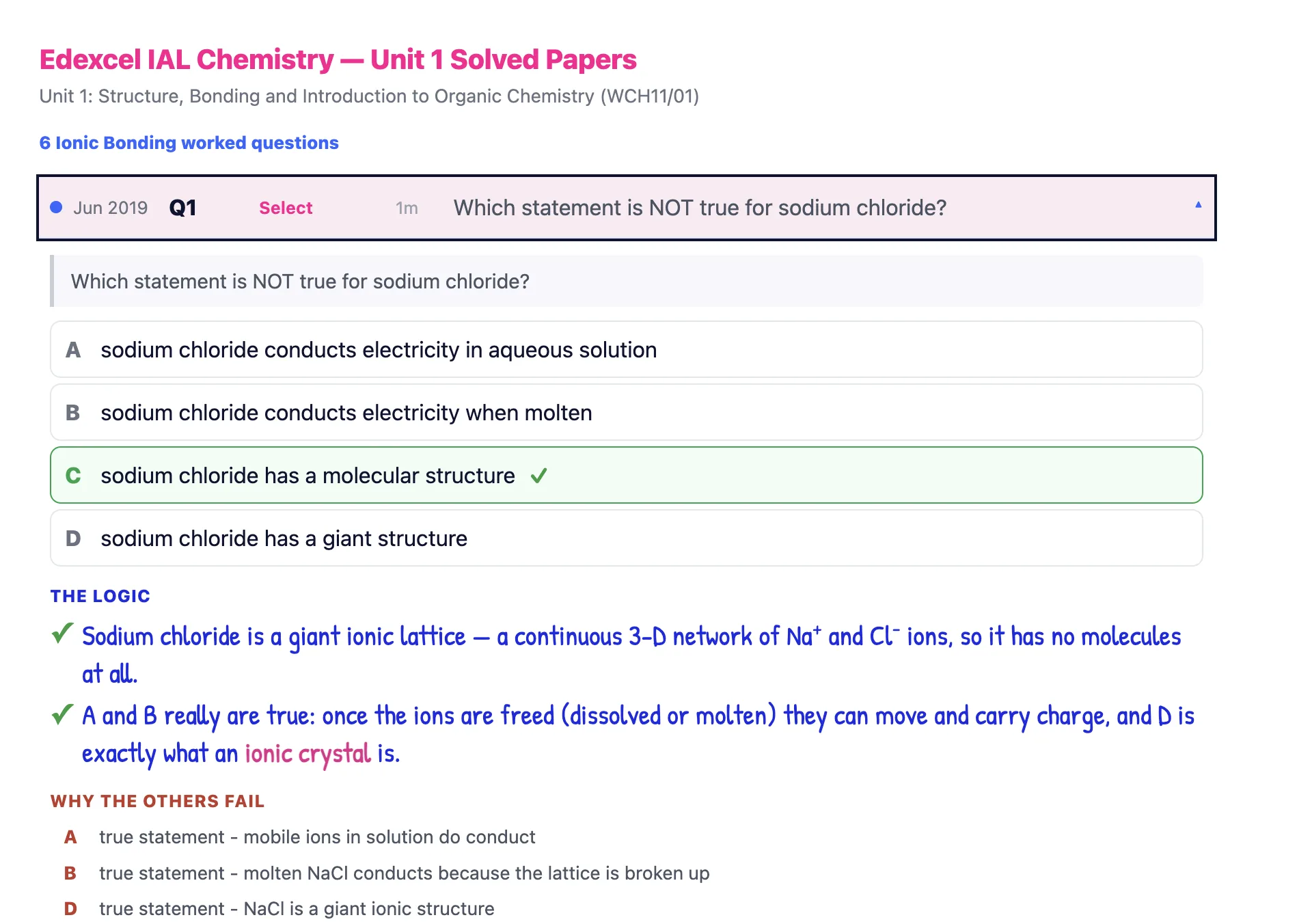
I have been building this solved archive for more than 12 years. Each year I solve the newest papers and add them, so the answers and the classification have grown paper by paper, not in one sitting. The counts here come from that archive, which is also what sits behind my solved IAL Chemistry past papers.
Two details will stop the numbers confusing you:
- Topic counts are whole-question. A long Section B question is filed under its main topic, so the shares are approximate. That is why I say "about" throughout.
- Question-type counts are a separate scan. They record whether a paper contains that type anywhere, including a one-mark multiple-choice item. So ionisation energy is the main topic of a question in 19 of 20 papers, but appears somewhere in all 20.
The paper itself has not changed shape. Pearson describes Unit 1 as 1 hour 30 minutes and 80 marks, opening with 20 multiple-choice questions, and the examiners confirm that Section B holds 60 marks of structured questions.
Which question types appear in every WCH11 paper?
Four question types have appeared in all 20 WCH11 papers: ionisation energy, a pV = nRT calculation, polar bonds or polar molecules, and a dot-and-cross diagram. If you can do these four without thinking, you have secured marks in every paper set so far.
Just behind them, in 15 to 17 of the 20 papers:
- Mass spectrum or mass spectrometer (17)
- Curly-arrow mechanism (17)
- Addition polymer or repeat unit (17)
- Skeletal formula, molecular formula, isotopes, electronic configuration, bond angle and atom economy (16 each)
- Relative atomic mass, melting-temperature trends, concentration in mol dm⁻³ and combustion or fuels (15 each)
A few findings surprised me. Parts per million was absent in June 2019 but has turned up about once a paper since October 2020. Percentage yield, which students practise a lot, appeared in only 5 papers. And a titration calculation has never appeared in a WCH11 paper; that belongs to Units 2 and 3.
How has WCH11 changed since 2019?
Shapes of molecules has grown from about 5% of marks in 2019–21 to about 13% in 2024–26, while alkenes and electrophilic addition has fallen from about 18% to about 5.5%. In the recent papers, bonding and shapes outweigh organic mechanisms.
Shapes of molecules is a newer arrival in this unit than most students realise: it was moved into Unit 1 from Unit 2 when the current specification began. I first noticed the rise in 2023, when a shapes question started to feel like a must-ask every series. In the most recent papers it has also been kinder, both in the questions and in how they are marked, so these are marks you should expect to collect.
Other movers between the first seven papers and the latest seven:
- Up: combustion and fuels (3.2% to 8.8%), bond fission and free radicals (5.9% to 8.0%), ionic bonding (1.2% to 7.1%), E/Z isomers (0.5% to 4.6%).
- Steady: formulae and amounts (17.5% to 15.2%), ionisation energy (9.1% to 8.4%).
- Down: the mass spectrometer (9.3% to 5.5%), periodicity (6.4% to 1.4%).
Ionic bonding is the quiet riser in that list. If you want to see how I teach it, there is a free ionic bonding trial lesson with the video, notes and worked questions.
One more shift matters as much as the topics. Drawing marks have grown from about 5 a paper in 2019 to 14–17 in some recent papers, and Section B is now often five or six shorter questions where it used to be four long ones. Shorter questions switch topic more often. This is where I see students struggle most: a question opens with organic chemistry, then asks for a molecular shape, and the change of topic pulls them away from what the question is asking.
Are January WCH11 papers different?
Yes. Across the seven January papers from 2020 to 2026, moles, shapes of molecules and ionic bonding took a bigger share than in the 20-paper average, and ionisation energy dropped to about 3% of marks because it was usually set as quick multiple choice.
| January papers | All 20 papers | |
|---|---|---|
| Formulae, equations and amounts | 18.9% | 16.2% |
| Shapes of molecules | 11.4% | 7.2% |
| Ionic bonding | 7.9% | 4.4% |
| Structure of the atom | 5.0% | 2.5% |
| The mass spectrometer | 5.9% | 8.8% |
| Ionisation energy | 2.9% | 8.6% |
Seven papers is a small sample, so treat this as a lean, not a rule. Ionisation energy still appeared in six of the seven; it just carried fewer marks. For the dates and the week-by-week order, use the January 2027 Unit 1 revision plan, which tells you when to revise. This page tells you what.
Small but certain, rare but huge
Some WCH11 topics are worth only one to three marks but turn up almost every time; others stay away for several papers and then arrive as a 20-mark question. You need a different plan for each.
Small but certain. Electronic structure (18 of 20 papers), electronegativity and polarity (17 of 20) and naming or safety (13 of 20) are nearly always there, usually as multiple choice. They are quick to revise and they are the cheapest marks on the paper.
Rare but huge. Covalent bonding was the main topic of a question in only 6 papers, yet reached 21 marks in one of them. Giant covalent structures and cracking each appeared in 9 papers and each reached 20 marks. Skip one of these and a single paper can cost you a grade.
Which definitions does WCH11 ask most?
Ionisation energy is the most-asked definition in WCH11: you were asked to define it or write its equation in 15 of the 20 papers. Isotopes comes next (9 papers), then metallic bonding (about 6), homolytic fission or free radical (about 5) and relative atomic mass (5).
I ask my students to learn ionisation energy both ways, in words and as an equation, and the word that must be in both is gaseous :
- In words: the energy required to remove one mole of electrons from one mole of gaseous atoms to form one mole of gaseous 1+ ions.
- As an equation: X(g) → X⁺(g) + e⁻
Leave out the state symbols, or "one mole", and the mark goes.
Definitions look like free marks, and the figures say otherwise. In June 2024 a relative atomic mass definition was repeated from the previous year, and only 39% of candidates scored both marks. The usual gap was the phrase "weighted mean". Exact wording like this is what the IAL Chemistry notes are written around.
Where do students lose marks in WCH11?
The average WCH11 mark sits at about 39 to 49 out of 80, so a typical candidate drops close to half the paper. Pearson's reports give a mean of 39 in June 2022, 39.3 in January 2023, 41.4 in October 2024, 44 in January 2025 and nearly 49 in June 2025. Section A usually averages about 12 to 15 out of 20.
The same errors come back in almost every report:
- Unit conversions in pV = nRT. This is the slip I see most often in my students' work, and it is nearly always the volume. Every volume has to be in m³: divide cm³ by 1,000,000 and dm³ by 1,000, so 250 cm³ is 2.50 × 10⁻⁴ m³. The October 2024 report names the cm³ to m³ conversion as the most common mark lost on that question, and the January 2024 report says the same about dm³. Temperature must be in kelvin too.
- Significant figures. If the question asks for three, give three. The January 2022 report lists the wrong number of significant figures among the marks lost in calculations.
- Missing or wrong mole ratios. Write the balanced equation first, then the ratio, then the calculation.
- Vague key terms. In bonding answers the mark often hangs on one phrase, such as "electrostatic force of attraction". In the June 2025 paper, candidates lost marks for leaving out "attraction" or "electrostatic" in exactly these answers.
Calculations make up about 20–26% of Section B, and Pearson requires at least 18 marks of maths in the paper. Fixing errors 1 to 3 protects a large block of marks with very little new learning.
What to revise first for WCH11
Revise in the order the marks fall. This is the checklist I would hand you today:
- Moles, formulae and equations. In every paper, about 13 marks.
- Ionisation energy. In 19 of 20 papers as a main topic; learn the definition and the equation with state symbols.
- Alkenes and mechanisms. Fewer marks lately, but still up to 36 in a single paper.
- Shapes of molecules and bond angles. The fastest-rising topic.
- Mass spectrometry and isotopes. In 16 of 20 papers.
- Dot-and-cross diagrams. In all 20 papers.
- pV = nRT with unit conversions. In all 20 papers.
Then move to full papers, and when a question changes topic halfway through, stop and re-read what that part is asking. If you would like this taught and marked with you, the IAL AS Chemistry course follows the same order. You can also message me on WhatsApp at +965 5137 5709 or email [email protected].
FAQ
Which topic carries the most marks in IAL Chemistry Unit 1 (WCH11)?
Formulae, equations and amounts of substance carries the most, at about 16% of all marks across 20 papers. It is the only topic to appear in every one of them, averaging about 13 marks a paper.
Is ionisation energy in every WCH11 paper?
Yes, an ionisation energy question of some kind has appeared in all 20 papers from June 2019 to January 2026. It was the main topic of a question in 19 of them, and you were asked for the definition or equation in 15.
Are January WCH11 papers easier than June papers?
The counts do not show January as easier, only as weighted differently. January papers have leaned towards moles, shapes of molecules and ionic bonding, with ionisation energy usually set as multiple choice.
What is the average mark in WCH11?
Pearson's examiner reports give means of about 39 to 49 out of 80. Section A usually averages about 12 to 15 out of 20.
Try a free Class