
IAL Biology Unit 5 Scientific Article January 2027: Release Date, Marks and Prep Checklist
The WBI15 pre-release article carries 20 of the 90 marks and is expected between 25 November and 9 December 2026 for the 20 January paper.

TL;DR: The IAL Biology Unit 5 scientific article for January 2027 has not been released yet; on Pearson's stated lead time it should reach teachers between 25 November and 9 December 2026. The article question is Question 8 and it is worth 20 of the 90 marks, not the 30 you will see quoted elsewhere. In the June 2025 paper, 14 of those 20 marks sat in parts worth only 1 or 2 marks each. The Unit 5 paper is on Wednesday 20 January 2027, in the morning. Use the two-part checklist below: one part for now, one for the day the article lands.
On this page
- When is the January 2027 article released?
- How many marks is the article worth?
- What does Question 8 look like?
- Where do you get the article, and which version?
- What you can do before the article arrives
- How to study the article once it is released
- Where students lose marks
- Sitting Unit 5 in January after an October attempt
- FAQ
When is the IAL Biology Unit 5 scientific article for January 2027 released?
The January 2027 Unit 5 scientific article has no announced release date yet, and Pearson's own lead time points to a window of 25 November to 9 December 2026. That window comes from counting back six to eight weeks from the exam.
Here is the working, so you can check it yourself. Pearson's January 2027 final timetable puts WBI15 on Wednesday 20 January 2027, morning session, 1 hour 45 minutes. Pearson has told teachers that the article is pre-released six to eight weeks before the exam. Eight weeks back from 20 January is 25 November. Six weeks back is 9 December.
Last year gives you a second reference point. For the January 2026 paper, Pearson said the article would be available close to 20 November, which was 54 days before that exam. The same lead this year lands on 27 November.
One caution from my own classes. The date Pearson publishes the article to teachers and the date it reaches your desk are not the same thing. In my experience students usually have it in their hands roughly five weeks before the exam, which this year means around mid-December. So ask your teacher or exams officer from 25 November, and chase if you still have nothing by 16 December.
How many marks is the Unit 5 scientific article worth?
The Unit 5 scientific article question is worth 20 marks out of 90, which is about 22% of the paper. It is not 30 marks, although you will see that figure repeated on plenty of revision resources.
You do not have to take my word for it. The June 2025 WBI15 question paper prints "Total for Question 8 = 20 marks" on a paper with a total of 90. Pearson's October 2024 examiner report says the article accounts for 22% of the total paper mark. And Pearson's scientific article FAQ document describes it as just over 20% of the marks.
Why does the number matter? Because it tells you how much time to give it. Twenty marks is more than any other single question on the paper, and it is the only question you can see coming weeks ahead.
That is why I tell my students Question 8 is the one they can secure. You already know what it is about. You have a head start that no other question gives you. It is such a waste not to prepare well for it.
What does Question 8 look like?
Question 8 is a run of short parts, usually worth 1 to 3 marks each, and every part points you to named paragraphs of the article. The table shows the June 2025 paper, part by part.
| Part | Command word | Where it points | Marks |
|---|---|---|---|
| (a)(i) | Name | Image before paragraph 1 | 1 |
| (a)(ii) | Calculate | Image before paragraph 1 | 2 |
| (b) | Suggest | Paragraphs 4 and 5 | 2 |
| (c) | Describe | Paragraph 5 | 2 |
| (d) | Describe | Paragraph 6 | 3 |
| (e) | Explain | Paragraphs 7 and 8 | 2 |
| (f) | Explain | Paragraph 14 | 2 |
| (g) | Calculate | Paragraph 15 | 1 |
| (h) | Explain | Paragraph 19 | 2 |
| (i) | Explain | Paragraphs 2, 3 and 20 | 3 |
| Total | 20 |
Question 8, WBI15 June 2025: ten parts, 20 marks. Fourteen of the 20 marks came from parts worth 1 or 2 marks. Source: Pearson Edexcel question paper.
Look at what that table tells you. There is no long essay here. Ten small questions, four different "Explain" parts, two calculations, and one simple "Name". Fourteen of the 20 marks came in bites of 1 or 2.
The questions also travel across the whole article, from the image before paragraph 1 right through to paragraph 20. So you cannot prepare the first page well and skim the rest.
If you want to see how this played out for the last series, my October 2026 Unit 5 article guide walks through that article in the same way.
Where do you get the article, and which version do you need?
Your teacher or exams officer gives you the article; students cannot download it directly from Pearson. Pearson's update says teachers download it with an Edexcel Online login from the teaching and learning materials section of the qualification page. If you are a private candidate, your exam centre should pass a copy on to you, so ask them early.
You may also hear about two versions. In recent series Pearson has published a standard WBI15_01 article and a WBI15_01A article for candidates sitting the regional paper, and your exams officer receives confirmation of which one applies to you. Use the one your centre names.
Don't lose sleep over this, though. From what I have seen of both versions, the questions are the same. The difference is the format of the paper: version A comes with a separate answer sheet. There is really not much between them.
One rule catches students out every series. You can annotate your copy as much as you like at home, but you cannot take it into the exam. You get a fresh, clean copy with the question paper. So your notes have to be in your head, not in the margins.
What you can do before the article arrives
You do not need the article in your hands to start preparing for Question 8. Pearson's guidance says the article questions can be synoptic and draw on Topics 1 to 7, so the work you do now on earlier units is not wasted whatever the article turns out to be about.
Checklist, part 1: before release
- Finish Topics 7 and 8 properly: respiration, muscles, homeostasis, coordination and gene technology.
- Go back over the big themes from Units 1, 2 and 4. In many series my students have had to revise all three for the article.
- Learn what each command word wants. "Describe" and "Explain" are marked differently, and Question 8 uses both.
- Work through two or three past Question 8s with their mark schemes, so the style stops being a surprise.
- Practise the short calculations: percentages, ratios, and reading values from a figure.
- Tell your teacher or exams officer you want the article the day it is released.
There is fresh practice material this week, too. Pearson's November update lists the October 2026 exam papers as published on 10 November, with the mark schemes following on 22 December. Ask your teacher for the October Unit 5 paper.
If Topics 7 and 8 still feel shaky, this is the gap to close first. My A2 Biology course covers both topics with exam practice, and the IAL Biology notes are written from the latest mark schemes and examiner reports. You can also map your other January papers around this one with the January 2027 timetable for Biology and Chemistry.
How should you study the Unit 5 article once it is released?
Study the article by reading it several times, linking every keyword to your specification, and then revising the topic it is built on. Pearson's FAQ document suggests the same core steps: make notes, link the content to the specification, and list the terms and techniques.
This is the method I use with my own students.
Checklist, part 2: after release
- Read the whole article through once without a pen, so you know the story.
- Read it again and highlight the keywords. Link each one to a specification point.
- Look up every term you do not know, including the ones that are not on your specification. Pearson is clear that these can be examined.
- Write your takeaways for each paragraph in one or two lines.
- Revise the main topic behind the article. If it is about immunology, revise the immune system from Unit 4. If it is about stem cells, go back to Unit 2.
- Write your own questions for each paragraph, using different command words, and answer them.
- Read the article again in the final week. By then it should feel familiar.
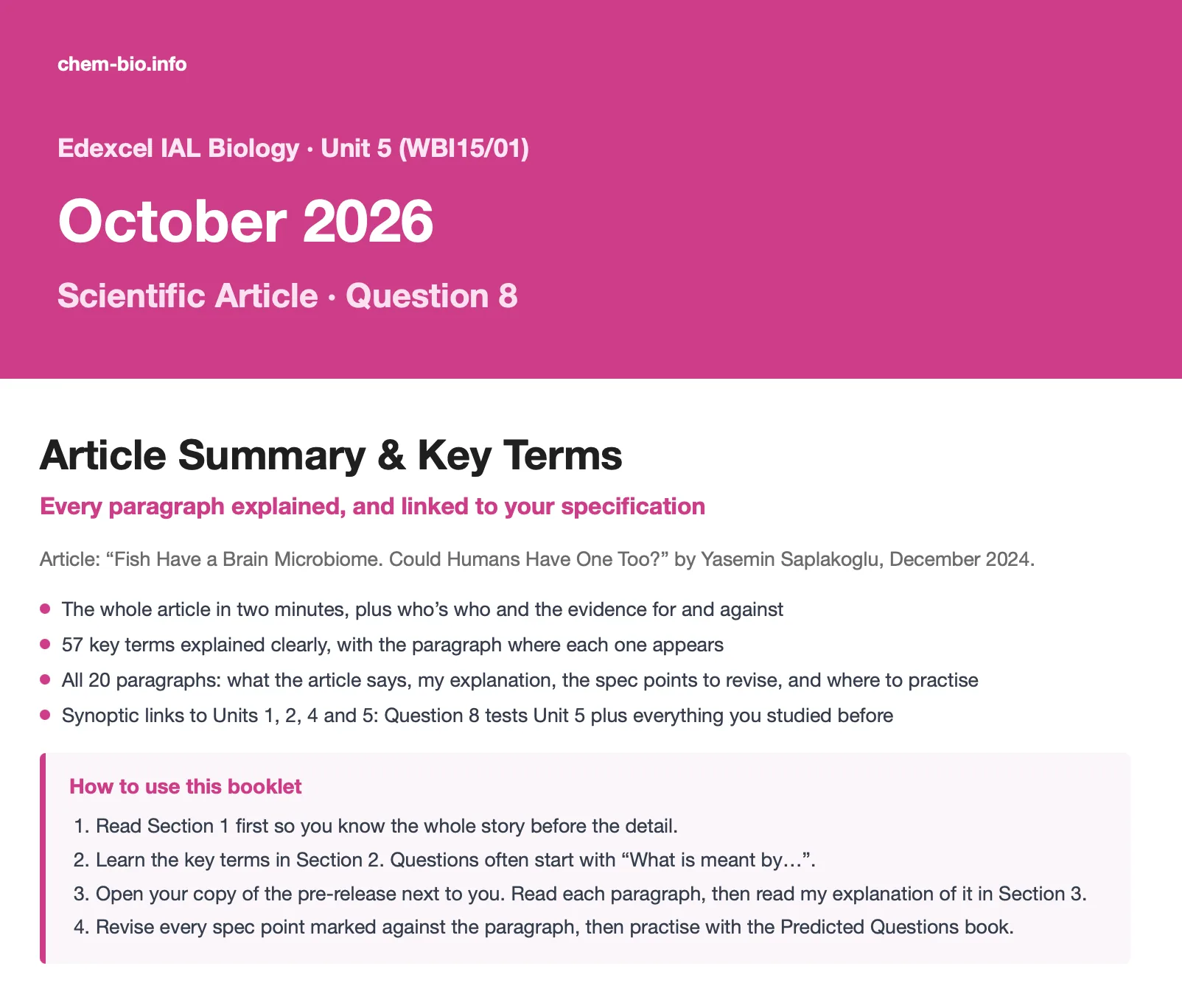
My October 2026 booklet: 57 key terms and all 20 paragraphs, each linked to the specification.
One point surprises students. The paragraph numbers printed next to each question do not usually hand you the answer. Pearson says the references are there to guide you to the relevant context. The answer comes from your own biology.
I also do two things for every series. I write a study guide with predicted questions for each paragraph, and I release a full-length video a couple of weeks before the exam. In the video I explain the article, go over all of the predicted questions, and show you how to link the article to the specification and which areas to revise. For the October 2026 paper, nearly 90% to 95% of the Question 8 questions were predicted in my Unit 5 study guide. The January 2027 Study Hub, with the article guide, predicted questions and the video, opens on 24 December 2026, and you can pre-book the Unit 5 January 2027 Study Hub now.
Where do students lose marks on the article?
Students lose most of their Question 8 marks on the direct 1- and 2-mark parts, not on the hard ones. This is what disappoints me most when I read their answers.
Most of the time students pour their effort into the difficult "Explain" and "Assess" questions. Then they forget the easy definitions. A term sits in the article for five weeks, nobody looks it up, and a simple "what is meant by" question goes unanswered.
Pearson's examiners describe the same pattern. The October 2024 examiner report noted more blank answers on the article question and linked that to a lack of preparation. A part on monoclonal antibodies was answered very poorly, with many blanks, because few candidates understood the term. On another part, many candidates repeated the wording of the question and earned nothing for it.
So here are three habits to build:
- Never leave a part blank. A 1-mark attempt costs you ten seconds.
- Do not copy the question back as your answer. Add the biology.
- Make a definitions list from the article and learn it like vocabulary.
Sitting Unit 5 in January after an October attempt
If you sat Unit 5 in October and you are sitting it again in January, you will walk into the January paper without your October result. Pearson's key dates show autumn series results reaching candidates on 21 January. The Unit 5 paper is the day before, on 20 January.
That means you cannot wait for a grade to tell you what to fix. You have to work it out yourself, and my strong recommendation is to work backwards.
- Get hold of your marked October script if your centre can request it. Ask your exams officer what is possible and by when.
- Go through it and see where things went wrong, question by question.
- Turn that into an action plan for your weaker areas, with dates.
If the script is not available in time, use the October question paper and, from 22 December, the mark scheme. Mark your memory of your own answers as fairly as you can. It is not perfect, but it shows you the pattern.
Students who resit with a clear picture of what went wrong tend to do better, because they already know the pacing of the paper. I have written more about that decision in October results and your January entry. And if you would like help building the plan, message me on WhatsApp at +965 5137 5709 or email [email protected].
FAQ
Can I take my annotated article into the Unit 5 exam?
No. You are given a fresh copy of the article with your question paper, and your annotated copy stays outside the exam room.
Do I need to learn terms in the article that are not on the specification?
Yes. Pearson's guidance says you should be able to understand and explain the biological terms used in the article, even when they are not listed in the specification. For techniques, you need the principles and how they link to your specification, not the detailed method.
Do the paragraph references in Question 8 contain the answers?
Usually not. They point you to the context for the question, and the marks come from applying your own biology to it.
How long should I spend on the Unit 5 scientific article?
Pearson does not set a time, and it will differ for each student. With 20 of the 90 marks at stake, give it regular sessions from the day you receive it, not one long read the night before.
Try a free Class


