IAL Biology Unit 1 (WBI11): What Comes Up Most — 21 Past Papers Analysed
Four topics carry 51% of all WBI11 marks. Here is the full ranking from 21 past papers, the question types set in every paper and where the marks are lost.

TL;DR: I counted every mark in 21 WBI11 past papers, January 2019 to January 2026, to find the WBI11 topics that come up most: 1,680 marks, sorted by topic. Cardiovascular disease carries the most, 16.3% of all marks, and it is the only topic set in all 21 papers. Four topics (cardiovascular disease, membranes and transport, biological molecules, and the heart and circulation) carry 51% of the marks between them. Every paper had a 6-mark levels question, a cardiovascular disease data question, a calculation and a definition, but a genetic cross appeared in only 10 of the 21.
If you are sitting Unit 1 in January 2027, your first question is what to revise first. The honest answer is in the papers, so I went through them.
The method is simple. I took 21 real WBI11 papers and gave every mark to a topic: 767 question parts, one by one. No predictions and no guesses, only what Pearson has already set.
The headline is cardiovascular disease. It is worth about 13 marks in every paper, more than any other topic, and it is the one my students practise least.
On this page
- Which WBI11 topics carry the most marks?
- How the 21 papers were counted
- Which question types appear in every WBI11 paper?
- How has WBI11 changed since 2019?
- Are January WBI11 papers different?
- Small but certain, rare but huge
- Which definitions does WBI11 ask most?
- Where do students lose marks in WBI11?
- What to revise first for WBI11
- FAQ
Which WBI11 topics carry the most marks?
Cardiovascular disease carries the most marks in WBI11: 274 of 1,680 marks (16.3%), set in all 21 papers. Together with membranes and transport, biological molecules, and the heart and circulation, the top four topics carry 861 marks, which is 51.2% of the paper.
Unit 1 is an 80-mark paper sat in 1 hour 30 minutes, and it covers Topics 1 and 2 of the Pearson specification: molecules, transport and health, then membranes, proteins, DNA and gene expression. Here is how those 80 marks have been shared out across 21 papers.
| Rank | Topic | Marks out of 1,680 | Share of marks | Papers it appeared in | Average per paper | Most in one paper |
|---|---|---|---|---|---|---|
| 1 | Cardiovascular disease: risk factors, studies and data | 274 | 16.3% | 21/21 | 13.0 | 24 (June 2023) |
| 2 | Cell membranes and transport | 218 | 13.0% | 20/21 | 10.4 | 19 (January 2024) |
| 3 | Biological molecules: carbohydrates, lipids, proteins | 211 | 12.6% | 20/21 | 10.0 | 21 (October 2025) |
| 4 | The heart and circulation | 158 | 9.4% | 17/21 | 7.5 | 15 (January 2022) |
| 5 | Mutation and genetic disorders | 156 | 9.3% | 16/21 | 7.4 | 18 (June 2021) |
| 6 | Inheritance and genetic crosses | 99 | 5.9% | 15/21 | 4.7 | 15 (October 2021) |
| 7 | Enzymes | 94 | 5.6% | 14/21 | 4.5 | 14 (June 2025) |
| 8 | DNA structure and replication | 90 | 5.4% | 13/21 | 4.3 | 13 (October 2022) |
| 9 | Blood clotting and atherosclerosis | 81 | 4.8% | 14/21 | 3.9 | 13 (January 2026) |
| 10 | Protein synthesis | 77 | 4.6% | 15/21 | 3.7 | 13 (June 2019) |
| 11 | Haemoglobin and the oxygen dissociation curve | 75 | 4.5% | 11/21 | 3.6 | 15 (June 2024) |
| 12 | Genetic screening and ethics | 43 | 2.6% | 9/21 | 2.0 | 10 (October 2021) |
| 13 | Water | 35 | 2.1% | 8/21 | 1.7 | 8 (January 2020, January 2024) |
| 14 | Diet and energy balance | 35 | 2.1% | 6/21 | 1.7 | 11 (June 2021) |
| 15 | Other (magnification, unit conversions, non-CVD studies) | 34 | 2.0% | 10/21 | 1.6 | 8 (June 2021) |
Two things in this table surprise my students every year.
The first is cardiovascular disease. It is the topic my students work on least, and it is their weakest. These questions are not built on the notes. They are built on studies: a table of risk factors, a graph from a drug trial, a claim you have to judge. Add blood clotting and atherosclerosis and the block reaches 355 marks, 21.1% of the paper, and more than half of those marks (197, or 55.5%) come from reading and judging data. You cannot memorise your way through that. You have to practise it.
The second is biological molecules. Many students spend weeks on carbohydrates, lipids and proteins because the topic comes first in the notes, and they treat it as the one that decides the grade. It is big, at about 10 marks a paper, but it is not the biggest, and it is the least predictable: from 0 marks in June 2025 to 21 in October 2025. It has also lost the most ground since 2019. Learn it well, but do not let it take time from cardiovascular disease.
If you want every one of these topics taught live and your answers marked, my IAL AS Biology course covers the whole of Unit 1.
How the 21 papers were counted
Every question part in 21 WBI11/01 papers, from January 2019 to January 2026, was given to one of 14 topics and its marks added up: 767 parts, 1,680 marks. Each paper's parts were checked against its printed total of 80.
The 21 sittings are every January, June and October paper in that range except June 2020, which was cancelled. October 2020 is included. From October 2025 onwards I used the WBI11/01 version of each paper.
Each part went to the one topic its mark points test, so a question on a drug that stops blood clotting counts as clotting if the marks are for the clotting cascade. Some parts were a judgement call, and a different call would move a few marks between neighbouring rows. So treat each share as a close guide, not a promise for your paper. The 34 marks under "Other" test skills that sit outside the 14 topics, such as magnification and unit conversion.
Question types were a separate pass. I recorded the type of every part and then counted how many papers each type appeared in.
I have been building this solved archive for more than 12 years. Each year I solve the newest papers and add them, and you can work through every one in the solved IAL Biology past papers, sorted by topic or by year.
Which question types appear in every WBI11 paper?
Five question types appeared in all 21 WBI11 papers: an explain question, a 6-mark levels question, a multiple-choice question, a calculation and a state-or-define question. A cardiovascular disease question built on data or a study was also in all 21.
Pearson's own examiners tell you these questions repeat. In the October 2024 examiner report, they note that how cholesterol raises the risk of heart disease has been "asked on numerous occasions". A question you can see coming is a question you can prepare.
Here is what the most important ones reward.
- The 6-mark levels question. It was in all 21 papers, and 16 papers had two. Together these questions carry 13.2% of all marks. What moves you up a level is the precise key terms, used in a logical order.
- Explain. This is the biggest single type, at 31.1% of all marks. "Explain" means give the reason, not describe what happens.
- Cardiovascular disease data. Read each graph or table on its own before you compare. In the January 2025 paper, candidates wrote general statements about four graphs at once and missed the marks for each one.
- A calculation. It was in every paper. Check the units on the axis, standard form and decimal places before you move on.
For the 6-mark question I teach one habit. Before you write, build a skeleton in the margin: the key terms you will use, then a plan of three parts, which are description, explanation and conclusion. It takes a minute. In my experience it is what separates a good answer from an excellent one.
Here is what that looks like on a real question: the 6-mark DVT question from January 2026, with the model answer and the mark points it hits.
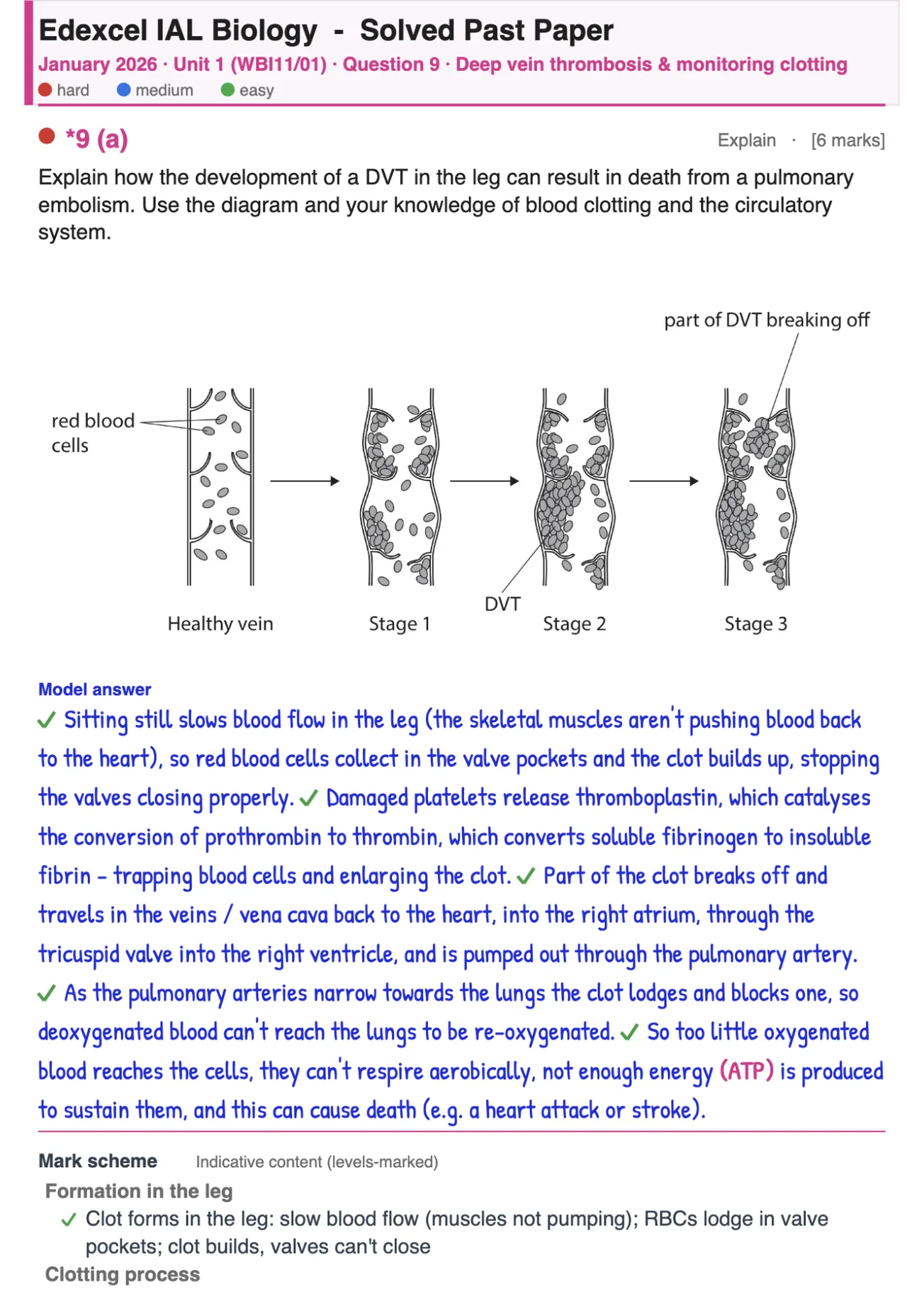 Solved 6-mark question: January 2026, Q9(a). Tap to enlarge
Model answer with the mark points ticked, from the solved WBI11 past papers.
Two question types are less common than students think. A genetic cross appeared in only 10 of the 21 papers. When it does come up, the marks are in the labels, not in the grid: write the parents' genotypes, the gametes and the offspring, then say which genotype gives which phenotype. A Punnett square on its own may not score.
Core practicals appeared in only 8 of the 21 papers, and 7 of those were Core Practical 4, the effect of temperature, pH and concentration on enzyme activity. The beetroot practical on membrane permeability, which my students find the hardest to explain in writing, appeared once, in January 2019. Core Practicals 1 and 2 did not appear at all.
How has WBI11 changed since 2019?
The biggest change since 2019 is the rise of cardiovascular disease, from 10.9 marks a paper in 2019–2021 to 14.4 marks a paper in 2022–2026. Enzymes rose too, from 2.9 to 5.5 marks a paper, while biological molecules fell the most, from 11.1 to 9.4.
The change I notice most in class is haemoglobin and the oxygen dissociation curve. It was set in 3 of the 8 papers from 2019 to 2021, and in 8 of the 13 papers since 2022. June 2024 gave it 15 marks.
You can see it in recent papers. October 2024 asked why fetal haemoglobin needs a higher affinity for oxygen, and the examiners reported that many candidates blamed low partial pressure when the point was oxygen moving from adult to fetal haemoglobin. June 2025 then asked candidates to explain how the structure of haemoglobin suits its function, and many only described the structure.
So learn the curve properly: what shifts it, why fetal haemoglobin sits to the left, and how to explain loading and unloading in terms of partial pressure and affinity.
Are January WBI11 papers different?
Not in what they test. The same five topics lead in January as in every session, only in a different order, and in my experience nothing is unique to one session.
In the 8 January papers, the top five were:
- Cell membranes and transport: 13.9 marks a paper (10.4 across all papers)
- Cardiovascular disease: 11.1 marks a paper
- Mutation and genetic disorders: 9.8 marks a paper (7.4 across all papers)
- Biological molecules: 8.2 marks a paper
- The heart and circulation: 6.1 marks a paper
The one topic January has given less is inheritance and genetic crosses, at 2.8 marks a paper against 4.7 overall. For January 2027, do not hunt for a "January pattern". Revise in the order the marks fall, and give membranes and mutation a little extra time.
Small but certain, rare but huge
In most subjects there are small topics you can bank because they come up every time. WBI11 has none. Every topic set in at least 16 of the 21 papers is also one of the big earners, at 7 marks a paper or more.
Nearly certain, not quite small. Inheritance and genetic crosses, protein synthesis, enzymes, blood clotting and atherosclerosis, and DNA structure and replication each appeared in 13 to 15 papers, worth about 4 to 5 marks a paper on average. Skipping any of them is a gamble you will lose about two papers in three.
Rare but huge. Diet and energy balance appeared in only 6 of the 21 papers, yet June 2021 gave it 11 marks. Haemoglobin, set in 11 papers, took 15 marks in June 2024. Blood clotting took 13 marks in January 2026, including the DVT question above. You cannot skip these and hope.
Definitions can also disappear and come back. In the June 2025 paper, candidates were asked to define correlation, and the examiners remarked that they had not asked for it "for a while".
Which definitions does WBI11 ask most?
Correlation is the definition WBI11 asks most: in 4 of the 21 papers. Gene and genotype were each asked in 3 papers, and allele, phenotype, mutation, semi-conservative replication and biological catalyst in 2 each.
Three definitions cost my students marks more than any others. This is the wording I teach, and it matches what the mark schemes credit.
- Correlation. A relationship between two variables, where a change in one goes with a change in the other. It does not show that one causes the other. The June 2025 examiners reported definitions worded so loosely that they implied causation.
- Mutation. A change in the base sequence of DNA. Students write about a change in the protein, but that is the effect. The definition is the cause.
- Primary structure. The sequence of amino acids in a polypeptide chain, joined by peptide bonds. The part students forget is the peptide bonds. It has not been asked as a straight definition in these 21 papers, but it has appeared in 3 papers in other forms, such as a gap-fill or how two proteins differ.
If definitions are your weak point, my IAL Biology notes mark every definition you must learn in mark-scheme wording.
Where do students lose marks in WBI11?
Students lose most WBI11 marks on technique, not on missing knowledge: the wrong response to a command word, vague wording and unlabelled working. These seven points come from Pearson's examiner reports and from my students' practice papers.
- Describing when the question says explain. In October 2024(Question 6), many candidates only described the data and scored one mark. In June 2025(Question 2b), the examiners had to point out that the command word was explain, not describe.
- Explaining without describing the data first. This is the opposite mistake, and I see it often in long data questions. State the trend with figures, then give the reason. I also see "assess" answered as if it said "explain".
- A genetic cross with no genotype-to-phenotype link. October 2024 (Question 3) and January 2025(Question 8) both report marks lost because candidates did not say which genotype gives which phenotype.
- "Gene" where the answer needs "allele". In October 2024 (Question 5), this kept candidates at level 1 in the extended answer. In Question 3 of the same paper, "the gene" or "the disorder" was not accepted for the allele on the X chromosome.
- One-sided extended answers. In January 2025 (Question 8), candidates were asked for advantages and disadvantages and often gave only one side.
- Vague wording in health questions. In June 2025 (Question 8b), "healthy diet" and "balanced diet" were too vague to score. In October 2024 (Question 6), calling plaque a "fatty deposit" did not gain the mark.
- Careless maths. January 2025 (Question 2): a value read from a graph without the "per hundred thousand" on the axis. June 2025: an answer not given in standard form (Question 8a) and percentages with too many decimal places (Question 1c).
One more from June 2025 (Question 7b): in enzyme answers, "the enzyme" is too vague. Write "the active site".
Before the exam, read the command words in Appendix 7 of the specification. The examiners point candidates to it in their reports, and it tells you exactly what each word asks for.
What to revise first for WBI11
Revise in the order the marks fall. This is the checklist I would hand you today, ranked by marks and by how often each topic is set.
- Cardiovascular disease: risk, studies and data. 13.0 marks a paper, in all 21 papers. Practise data questions, not just notes.
- Cell membranes and transport. 10.4 marks a paper, in 20 of 21, and 13.9 in January papers.
- Biological molecules. 10.0 marks a paper, in 20 of 21.
- The heart and circulation. 7.5 marks a paper, in 17 of 21.
- Mutation and genetic disorders. 7.4 marks a paper, in 16 of 21, and 9.8 in January papers.
- Inheritance and genetic crosses. 4.7 marks a paper, in 15 of 21. Label every step.
- Enzymes. 4.5 marks a paper, in 14 of 21, and rising since 2022.
Finish the content three to four weeks before the exam, then move to full papers and spend the last days on your own repeated mistakes. For the week-by-week version, use my Unit 1 revision plan for January 2027, and for the content itself, everything you must revise for IAL Biology Unit 1.
It works when time is short. One of my students finished his October exams with about six weeks left before January and very little guidance. He followed this order and the revision sessions, and scored close to the full 120 UMS in Unit 1.
Sitting Chemistry in the same series? The same count is done for WCH11 topics that come up most.
12 live revision sessions on Zoom, from Monday 30 November to the WBI11 exam on Friday 8 January. You solve 20+ full past papers at home and Mr. Hosni marks every one. Every session is recorded.
$100 · $85 per subject until 30 November with code JAN27 · $150 with Chemistry too
See the 12 sessions and enrolYou can also message me on WhatsApp at +965 5137 5709 or email [email protected].
FAQ
Which topic carries the most marks in IAL Biology Unit 1 (WBI11)?
Cardiovascular disease carries the most, at 16.3% of all marks across 21 papers from January 2019 to January 2026. It is the only topic set in every one of them, at about 13 marks a paper.
Is a genetic cross in every WBI11 paper?
No, a genetic cross appeared in 10 of the 21 papers counted, so about half. When it does, label the parents, the gametes and the offspring, and match each genotype to its phenotype.
Are January WBI11 papers easier than June papers?
The counts do not show January as easier, only as weighted slightly differently. The same five topics lead in January, with more marks on membranes and transport and on mutation, and fewer on genetic crosses.
How many core practicals are tested in WBI11?
Four core practicals belong to Unit 1, but in 21 papers only Core Practical 4 (enzyme activity) came up regularly, in 7 papers. Core Practical 3 (membrane permeability) appeared once, and Core Practicals 1 and 2 not at all.
Try a free Class