
IGCSE Chemistry Topical Past Papers With Answers: Every 0620 Topic Mapped to Paper 2, 4 and 6
All 12 Cambridge IGCSE Chemistry topics sorted by paper, with June 2026 grade thresholds and one worked answer showing where the marks sit.

TL;DR
IGCSE Chemistry topical past papers with answers are real Cambridge 0620 questions sorted by syllabus topic and paired with mark-scheme answers, so a student can drill one topic until it is secure instead of sitting a whole paper to find one weak area. In my classified bank of 36 Extended Paper 4s from 2021 to 2026, organic chemistry averages 17 marks out of 80, and the top four topics together take 55 marks of every paper. Paper 6 is built around the same four question slots every session, with the identification question in all 36 papers. The June 2026 thresholds put an A* at 175 of 200 weighted marks, which is 87.5% across the three papers. The table below maps all 12 topics to the paper and the question where they appear, and the worked answer at the end shows how a five-mark organic calculation is marked.
On this page
- What are IGCSE Chemistry topical past papers with answers?
- Which 0620 topics carry the most marks in Paper 2, 4 and 6?
- How many topical marks make an A* after June 2026?
- Where are marks lost, topic by topic?
- Worked answer: June 2024 Paper 43, Question 7(a)
- Topical first or full papers first? A plan to the 2027 exams
- FAQ
What are IGCSE Chemistry topical past papers with answers?
IGCSE Chemistry topical past papers with answers are past Cambridge 0620 exam questions regrouped by syllabus topic, each with a mark-scheme answer attached, so that a student practises one topic at a time rather than one sitting at a time. A full past paper tells you a score. A topical set tells you which of the 12 topics produced that score, and that is the information a revision plan needs.
The "with answers" part matters more than it sounds. A bare answer key tells a student that the answer to a mole calculation is 0.25. A mark-scheme answer tells them that the first mark was for dividing by the relative formula mass, the second for the ratio and the third for the final value, so a student who wrote 0.25 with no working knows they would have scored one mark out of three, not three. That is how Cambridge marks, and it is how every question in my Cambridge IGCSE Chemistry solved past papers is answered: the question, the mark scheme point by point, a worked answer in the words a marker is looking for, and a note on where the marks are usually lost.
The books cover Papers 2, 4 and 6 from 2019 to 2026 and file every question under the 12 topics of the current 0620 syllabus for 2026–2028. The syllabus sets the three Extended papers as Paper 2, 40 multiple-choice questions worth 30%; Paper 4, 80 marks of structured questions worth 50%; and Paper 6, the 40-mark Alternative to Practical worth 20%. The rest of this post follows that split, because a topic that dominates Paper 4 can be almost invisible in Paper 6, and a student who revises by topic without knowing which paper the topic lands in is revising blind.
Which 0620 topics carry the most marks in Paper 2, 4 and 6?
Organic chemistry carries the most marks in Paper 4, averaging 17.0 of 80 across the 36 Extended papers from February 2021 to February 2026 in my classified bank, followed by atoms, elements and compounds at 13.7, chemical reactions at 12.9 and acids, bases and salts at 11.6. Those four topics take 55 marks of every 80-mark paper. The table maps all 12 topics across the three papers.
| 0620 topic | Paper 2 syllabus share (of 40 MCQs) | Paper 4 average marks (of 80) | Paper 4 usual question | Paper 6 skill tested |
|---|---|---|---|---|
| 1 States of matter | 2 sub-topics ≈ 1.6 | 0.8 | Q1 | Rarely tested |
| 2 Atoms, elements and compounds | 7 sub-topics ≈ 5.7 | 13.7 | Q1–Q3, mostly Q2 | Rarely tested |
| 3 Stoichiometry | 3 sub-topics ≈ 2.4 | Spread through 28 of 36 papers as calculation parts | Inside other questions | Titration calculation (Q2) |
| 4 Electrochemistry | 2 sub-topics ≈ 1.6 | 6.2 | Q2–Q3 | Electrolysis Q1 (3 of 36 papers) |
| 5 Chemical energetics | 1 sub-topic ≈ 0.8 | 2.8 | Q4–Q5 | Energy-change data question (Q2, 11 of 36 papers) |
| 6 Chemical reactions | 4 sub-topics ≈ 3.3 | 12.9 | Q3–Q5, mostly Q4 | Rate-of-reaction data question (Q2, 12 of 36 papers) |
| 7 Acids, bases and salts | 3 sub-topics ≈ 2.4 | 11.6 | Q3–Q5, mostly Q4 | Titration question (Q2, 14 of 36 papers); salt preparation plans (Q4) |
| 8 The Periodic Table | 5 sub-topics ≈ 4.1 | 6.7 | Q1–Q2, can appear anywhere | Rarely tested |
| 9 Metals | 6 sub-topics ≈ 4.9 | 5.9 | Q1 or Q6 | Metal and alloy plans (Q4) |
| 10 Chemistry of the environment | 3 sub-topics ≈ 2.4 | 1.4 | Q1 | Rarely tested |
| 11 Organic chemistry | 8 sub-topics ≈ 6.5 | 17.0 | Q5–Q7, mostly Q6 | Alcohol-fuel plans (Q4) |
| 12 Experimental techniques and chemical analysis | 5 sub-topics ≈ 4.1 | 0.7 | Q1 | Apparatus Q1; identification Q3 in 36 of 36; planning Q4 in 36 of 36 |
Paper 4 figures are averages over 36 papers (variants 41, 42 and 43 from May/June and October/November, plus variant 42 from February/March) with each whole question filed under its dominant topic. Paper 6 figures come from the matching 36 Paper 6s. Topic numbering follows the 0620 syllabus for 2026–2028.
How to read the Paper 2 column
Cambridge does not publish a topic-by-topic breakdown for the multiple-choice paper, and I have not pretended to have one. The Paper 2 column instead shows each topic's share of the 49 numbered sub-topics in the syllabus, scaled to 40 questions, as a guide to how much of the paper a topic can reasonably claim. It is a syllabus weighting, not a question count. In my experience of teaching the paper, the questions students get wrong are not spread evenly across those 49 sub-topics: they cluster in organic chemistry, in mole calculations, and in redox and electrolysis, which is why the three multiple-choice sessions in my course are built around exactly those areas. If Paper 2 is your weak paper, the 28-day Paper 2 revision plan walks through it day by day.
Two cautions on the Paper 4 column. First, the 0.7 against experimental techniques does not mean the topic is unimportant; it means Cambridge tests it in Paper 6 instead, where it fills three of the four questions. Second, stoichiometry has no average of its own because it almost never gets a question of its own. In 28 of the 36 papers, mole and formula calculations appear as parts inside questions filed under organic chemistry, acids or chemical reactions. Treat stoichiometry as a skill that runs through the whole paper, not as a topic that can be left until last.
How many topical marks make an A* after June 2026?
In the June 2026 series an A* in Extended Chemistry needed 175 of the 200 weighted marks across Papers 2, 4 and 6, an A needed 150, a B 121 and a C 93, according to Cambridge's June 2026 grade threshold table for 0620. The same table gives the grade A line on each component as 28 of 40 on Paper 2, 62 of 80 on Paper 4 and 30 of 40 on Paper 6, and it notes that grade A* does not exist at the level of an individual component.
The 200-mark total is a weighted one, and the weighting is what turns topical scores into a grade. Paper 2 counts 1.5 times (40 raw marks become 60), Paper 4 counts 1.25 times (80 become 100) and Paper 6 counts once (40 stay 40). A student who scored 34 on Paper 2, 68 on Paper 4 and 36 on Paper 6 would have a weighted total of 51 + 85 + 36 = 172, three marks short of the A* line even though every component was comfortably above its grade A threshold. That is the arithmetic behind the advice I give every Extended candidate: an A* is an 87.5% average, so there is no paper you can afford to treat as the easy one.
Put the table above next to those thresholds and the topical priorities write themselves. On Paper 4 alone, organic chemistry plus atoms, elements and compounds average 31 marks, half the grade A threshold for the paper. A student who has those two topics at near-full marks before they open a single full paper has done the most efficient revision available to them. I keep a longer explanation of the June 2026 numbers, including Biology, in my post on the June 2026 IGCSE grade thresholds, and the February/March 2027 targets for students in India in the IGCSE Chemistry March series guide.
Where are marks lost, topic by topic?
The marks lost in IGCSE Chemistry cluster in a small number of places: drawing and naming organic structures in Paper 4, mole arithmetic in both written papers, and five repeat errors in Paper 6 that between them account for 176 flagged question parts in my bank. Topical practice with answers is the only kind of practice that targets these directly, because a student sitting a full paper meets each of them once, while a student working a topic meets the same error ten times in an evening.
Start with Paper 4 organic chemistry, the biggest topic on the paper. My bank tags the command word on every one of its 403 marked parts, and the pattern is unambiguous: Name carries 135 marks, State 128, Draw 97 and Complete 81. Nearly a third of the organic marks are for drawing or completing a structure, a displayed formula, a polymer repeat unit or an equation, and these are the marks that separate a B from an A. The only specific error that repeats verbatim across Cambridge's examiner comments in my organic bank is a misspelling, propanoate written as propanate or propionate, which costs the mark every time.
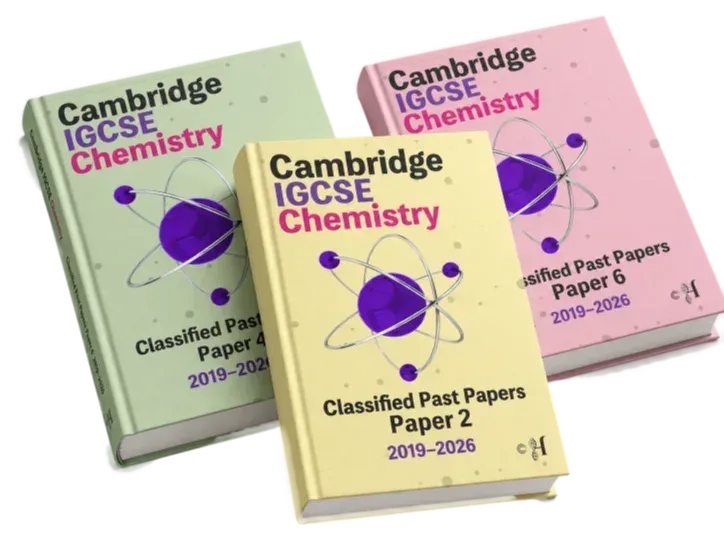
The classified solved past papers file every Paper 2, 4 and 6 question from 2019 to 2026 under the 12 syllabus topics, each with its mark scheme and a worked answer.
Paper 6 is more predictable than students expect. Every one of the 36 papers in my bank has an identification question at Question 3, averaging 8.9 marks, and a planning question at Question 4, averaging 6.0 marks, with an apparatus question at Question 1 in 30 of them. The large data question at Question 2 rotates between rates (12 papers), titration (14) and energy changes (11). Inside the identification question, the flame test has appeared in 26 of 36 papers, aqueous ammonia dropwise then in excess in 22, silver nitrate for halides in 19, and sodium hydroxide and barium nitrate in 17 each. Those five tests, with their expected observations, are the first thing I make a Paper 6 student learn.
The five errors that repeat most often across my Paper 6 bank, counted as the number of question parts whose marking notes flag them, are:
- Wrong behaviour in excess reagent: saying a precipitate dissolves when it stays, or the reverse (42 parts, almost all in the Question 3 identification question).
- An awkward, non-linear or too-small graph scale (44 parts, split between the rates and energy data questions).
- Choosing a burette or pipette over a measuring cylinder and justifying it as "quicker" or "easier" instead of "more accurate" (33 parts).
- Vague answers such as "impurities" or "to make it work" where a specific reason was needed (30 parts).
- Inconsistent decimal places in a results table, 21 instead of 21.0 (27 parts).
Close behind are a missing unit (26), no construction lines on a graph read-off (24) and "bubbles" instead of "effervescence" (24). If your child is losing Paper 6 marks, my separate post on how to score 35 out of 40 on IGCSE Chemistry Paper 6 goes through each question slot, and the solved Paper 6 flipbook shows a whole paper answered the way the mark scheme wants.
On the planning question, half of the 36 papers in my bank ask for an investigation with an independent variable, most often a comparison between samples or products (5 papers), temperature (4), the type of metal, alcohol fuel or catalyst (2 each). The other half ask for a method with no variable at all: find a quantity such as solubility or percentage by mass (7 papers), prepare a salt (3), separate or extract (3). Students who have only rehearsed the "change one variable" template are caught out by the second kind, which is why the worked example below is one of those.
Worked answer: June 2024 Paper 43, Question 7(a)
Question 7(a) of the June 2024 Paper 43 is a five-mark organic calculation that is answered in four lines and marked in five places, and it is the kind of question a topical set lets a student practise a dozen times in a row. The question, filed under organic chemistry in my bank, gives the percentage composition of a hydrocarbon and asks first for its empirical formula and then, for a second compound, its molecular formula.
Part (i), three marks, says compound A is 83.33% carbon and 16.67% hydrogen by mass, and asks for the empirical formula. The three marks are for three steps. First, divide each percentage by the relative atomic mass: 83.33 ÷ 12 = 6.94 for carbon and 16.67 ÷ 1 = 16.67 for hydrogen. Second, divide both by the smaller number: 1 : 2.4. Third, scale to whole numbers: 1 : 2.4 is 5 : 12, so the empirical formula is C₅H₁₂. The mark most often lost is the second: students who round 2.4 to 2 write CH₂ and lose the last two marks together. The ratio has to be scaled up, not rounded down.
Part (ii), two marks, says compound B has the empirical formula C₂H₅ and a relative molecular mass of 58, and asks for the molecular formula. The first mark is for the mass of the empirical unit, (2 × 12) + (5 × 1) = 29. The second is for 58 ÷ 29 = 2 and the formula C₄H₁₀. Written in full, the answer is two lines, which is why students skip the working; written without the 29, it scores one mark, not two, because the mark scheme credits the unit mass separately.
A Paper 6 planning answer marked the same way
For comparison, here is a planning question with no independent variable. In June 2025, Question 4 on Paper 62 of 0971 (the nine-point-scale twin of 0620, with identical papers) asked, in outline, for a plan to find the solubility of magnesium sulfate in water at 50 °C in grams per 100 cm³, given the solid, distilled water and ordinary laboratory apparatus. The scheme offers seven creditable points and awards any six: measure 100 cm³ of water into a beaker; heat it to 50 °C; keep it at 50 °C; add the salt a little at a time until no more dissolves; stir; filter off the undissolved solid; and take the measurement that gives the solubility, by evaporating the filtrate to dryness and weighing the residue. With exactly 100 cm³ of water, that mass is the solubility, and Cambridge's examiner report for that paper, which sits next to the question in my bank, notes that students lost marks for dividing it by 100 for no reason, for not saying what each piece of apparatus was for, for leaving out the stirring and for washing the residue.
Topical first or full papers first? A plan to the 2027 exams
Topical practice should come first and full papers last, in a ratio of roughly three topical sessions to one timed paper until the final month, when the ratio reverses. The reason is in the table above: a full paper samples each topic once, so a student who sits ten full papers has seen organic chemistry ten times and chemical energetics perhaps seven, with no control over the order. A topical set lets them do all of the Paper 4 organic questions from 2021 to 2026 in two evenings, and the mark-scheme answers tell them which of the four command words they are losing marks on.
For the February/March 2027 series in India, Cambridge's March 2027 series calendar puts the exam period at 3 February to 4 March 2027, with final entries on 27 November 2026 and results on 13 May 2027. That leaves about thirteen weeks from today, which I would split into seven weeks of topical work, in the order of the Paper 4 column (organic chemistry, then atoms, elements and compounds, then chemical reactions, then acids, bases and salts, then the rest), four weeks of alternating topical and full papers, and the final fortnight of timed papers only, Paper 6 included.
For the June 2027 series, Cambridge has not yet published the key dates. The June 2026 key dates ran from 23 April to 9 June with results on 18 August, and June 2027 can be expected to follow the same shape. June candidates have the luxury of a full topical cycle before Christmas and a second one after, and I plan my IGCSE Chemistry course that way: one live session a week to teach the content and a second, on a different evening, to work the topical questions on it, with the IGCSE Chemistry notes eBook as the text we work from.
Two practical notes. All three Extended papers must be worked topically, not just Paper 4, and Paper 6 should be started earliest because its marks are the most predictable. And a topical set is only as useful as its answers: if the answers are a bare key, with no mark-scheme breakdown, the student learns that they were wrong but not which mark they dropped. The classified solved past papers hub lists what I have for both boards, and if you want to know which topics your child should start with, send a recent mock score by WhatsApp to +965 5137 5709 or email [email protected] and I will tell you.
FAQ
What are IGCSE Chemistry topical past papers with answers? They are real Cambridge 0620 exam questions sorted by syllabus topic and paired with mark-scheme answers, so a student can practise one topic until it is secure. The answers show how each mark is awarded, not just the final value.
Which topic is worth the most marks in IGCSE Chemistry Paper 4? Organic chemistry, averaging 17 of 80 marks across the 36 Extended Paper 4s from 2021 to 2026 in my classified bank. Atoms, elements and compounds, chemical reactions, and acids, bases and salts follow, and together the four topics take 55 marks of every paper.
How many marks do you need for an A* in IGCSE Chemistry? In June 2026 an A* needed 175 of 200 weighted marks across Papers 2, 4 and 6, which is 87.5%. Paper 2 is weighted 1.5 times, Paper 4 1.25 times and Paper 6 once.
Should students do topical past papers or full papers first? Topical first, roughly three topical sessions to every timed full paper, until the final month before the exam. In the last few weeks the ratio reverses and timed full papers take over.
Try a free Class


