
Cambridge IGCSE Chemistry Syllabus 2026-2028 (0620/0971)
Cambridge IGCSE Chemistry syllabus for 2026, 2027 and 2028 (0620 and 0971): every learning objective from all 12 topics, with Core and Extended content marked, as an interactive tick-off checklist. Tick each point as you master it (progress is saved on this device), and see instantly which content is Core and which is Extended-only Supplement. Works for both the A*–G route (0620) and the 9–1 route (0971): the content is identical.
Core vs Extended — how the Cambridge IGCSE Chemistry papers work
Core candidates sit Paper 1 (Multiple Choice, 45 min, 40 marks, 30%) and Paper 3 (Theory, 1 h 15, 80 marks, 50%). Both test Core content only, and grades C–G are available.
Extended candidates sit Paper 2 (Multiple Choice, 45 min, 40 marks, 30%) and Paper 4 (Theory, 1 h 15, 80 marks, 50%). These test the Core and the Supplement — the points badged SUPPLEMENT below — and grades A*–G are available. Aiming for A*–C? You need everything on this page.
Everyone also sits one practical component worth 20%: Paper 5 (Practical Test, 1 h 15) or Paper 6 (Alternative to Practical, 1 h). Both assess the same experimental skills — the badged PRACTICAL points and all of Topic 12 are the skills they assess.
Open the Chemistry notes and solved papers
Real pages from the materials built on this exact syllabus — tap a cover to flip through it here.
 Chemistry Notes 2026–2028
Every definition, equation and test in mark-scheme words
📖 Tap to open
Chemistry Notes 2026–2028
Every definition, equation and test in mark-scheme words
📖 Tap to open
 Paper 4 Solved Past Papers
Calculations and explanations, step by step
📖 Tap to open
Paper 4 Solved Past Papers
Calculations and explanations, step by step
📖 Tap to open
 Paper 6 Solved Past Papers
Alternative to Practical, solved for the marks
📖 Tap to open
Paper 6 Solved Past Papers
Alternative to Practical, solved for the marks
📖 Tap to open
Every past-paper question sorted by these exact syllabus topics
Cambridge IGCSE Chemistry Papers 2, 4 and 6 from 2019–2026, fully solved and classified topic by topic — so when you tick "Stoichiometry" here, you can practise every mole question the examiners have ever set.
Get the Classified Solved Past Papers → See the Chemistry Notes 0620About the Cambridge IGCSE Chemistry syllabus (0620 and 0971)
The Cambridge IGCSE Chemistry syllabus is published by Cambridge International (Cambridge Assessment International Education). The current version covers examinations in 2026, 2027 and 2028 and is organised into 12 topics: states of matter, atoms, elements and compounds, stoichiometry, electrochemistry, chemical energetics, chemical reactions, acids, bases and salts, the Periodic Table, metals, chemistry of the environment, organic chemistry, and experimental techniques and chemical analysis. Every examinable idea is written as a numbered learning objective (for example 3.3.5), which is exactly what this checklist tracks — 252 points in total.
There are two syllabus codes with identical content: 0620 is graded A*–G and 0971 is the 9–1 graded version used mainly by UK schools. Whichever your school enters you for, this is your syllabus. The content is split into Core (all candidates) and Supplement (Extended candidates only, shown in the right-hand column of the official document) — Extended candidates need both, including the full mole concept, half-equations, the Haber and Contact processes and condensation polymers.
Practical skills are assessed on Paper 5 or Paper 6 rather than through coursework. Topic 12 covers the experimental techniques — titration, chromatography, separation, and the tests for ions and gases — and those points are badged PRACTICAL above.
Use this page as your master revision tracker: study each topic in the Cambridge IGCSE Chemistry course, tick each point once you can answer exam questions on it, then confirm it with real questions from the classified solved past papers (2019–2026). Sitting this October or November? Follow the Oct/Nov 2026 Chemistry revision plan. Also taking Biology? Use the matching Cambridge IGCSE Chemistry syllabus checklist. Edexcel student instead? See the Edexcel IGCSE Chemistry specification explained.
Cambridge IGCSE Chemistry syllabus — FAQ
What is the difference between 0620 and 0971?
Nothing in the content. 0620 is Cambridge IGCSE Chemistry graded A*–G; 0971 is Cambridge IGCSE (9–1) Chemistry graded 9–1. The syllabus topics, papers and questions are the same, so this checklist covers both.
Which years does this syllabus cover?
The current syllabus is for examinations in 2026, 2027 and 2028. Cambridge publishes it as one document for all three years. Students in India sitting the February/March series use the same syllabus; see how many marks an A* needs in IGCSE Chemistry in the March series.
What is the difference between Core and Extended in IGCSE Chemistry?
Core candidates sit Papers 1 and 3 on Core content only and can achieve grades C–G. Extended candidates sit Papers 2 and 4 on Core plus Supplement content — including full mole calculations, ionic half-equations and the Haber and Contact processes — and can achieve A*–G. The Supplement points are badged SUPPLEMENT in this checklist.
Which papers do I sit for Cambridge IGCSE Chemistry?
Three: a multiple-choice paper (1 Core or 2 Extended, 30%), a theory paper (3 Core or 4 Extended, 50%) and a practical paper (5 Practical Test or 6 Alternative to Practical, 20%).
Is the syllabus the same as a specification?
Yes. Cambridge calls the document a syllabus; Edexcel calls theirs a specification. Both mean the official list of everything that can be examined.
How many topics are in the Cambridge IGCSE Chemistry syllabus?
12 topics: states of matter; atoms, elements and compounds; stoichiometry; electrochemistry; chemical energetics; chemical reactions; acids, bases and salts; the Periodic Table; metals; chemistry of the environment; organic chemistry; and experimental techniques and chemical analysis.
See how to move from reading Chemistry notes to applying knowledge in exam questions. The video explains how exam-focused notes, mark-scheme language, flashcards and quizzes help you spot misconceptions and prepare for past-paper practice.
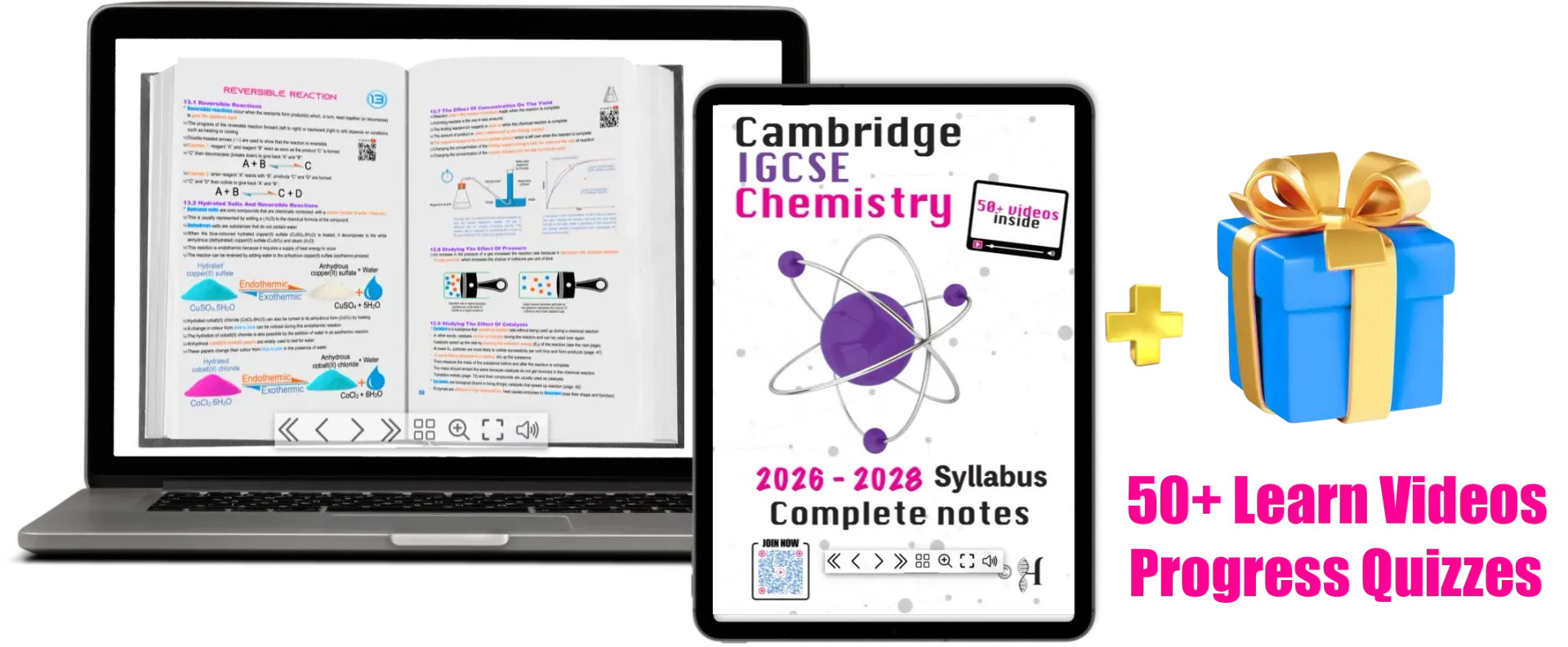
Turn this syllabus checklist into an A*
The complete Cambridge IGCSE Chemistry course: 60 recorded lessons covering all 12 topics, notes in mark-scheme language for the 2026–2028 syllabus, Paper 2 MCQ quizzes, solved Papers 4 and 6, and WhatsApp support from Mr Hosni.
Explore the IGCSE Chemistry Course → Free Chemistry Revision Guide Oct/Nov 2026 Revision Plan