Cambridge IGCSE Chemistry Papers 2, 4 & 6

Cambridge IGCSE Chemistry Notes

Calculations worked step by step, reactions in clear patterns, answers in mark-scheme wording.

Cambridge Chemistry gets overwhelming when every topic feels separate. These notes reduce each one to the essential ideas, equations and exact wording — with Paper 6 experiment support built in.

Digital eBooks · Instant online access · Phone, tablet and computer · Updated when the syllabus changes
Cambridge IGCSE Chemistry Complete Notes eBook cover for 0620 and 0971, 2026–2028 syllabus
20,000+ copies sold in 2025 40+ countries 21+ years teaching 5 published textbooks

Is this the right book for you?

Board
Cambridge (CAIE)
Syllabus codes
0620 & 0971
Papers covered
Papers 2, 4 and 6
Syllabus years
2026–2028

Written for students sitting Cambridge IGCSE Chemistry 0620 or 0971, at either tier, across Papers 2, 4 and 6. Not your syllabus? Use the book finder.

Best value $40 $50 Save $10

Biology + Chemistry bundle — get both Cambridge IGCSE science books together and save $10.

The Chemistry problem

Chemistry punishes vague answers — these notes make yours precise

Mole calculations, ionic equations, tests for ions and gases: each needs an exact method and exact words. These notes give you both, so you stop losing marks to phrasing.

  1. Reduce the topic

    Every chapter is cut to the essential ideas, equations and definitions — no padding.

  2. Work the calculation

    Mole, concentration and yield problems are worked step by step, with units carried through every line.

  3. Nail the wording

    Tests, observations and explanations are written the exact way the mark scheme awards them.

  4. Prove the practical

    Paper 6 experiments are explained so you understand why each step is done, not just what to write.

Built for the exam

What makes these Chemistry notes score

Mark-scheme wording

Tests, observations and explanations phrased exactly as 0620 examiners award them.

Worked calculations

Moles, concentration, yield and empirical formulae — solved step by step with units.

Paper 6 experiment support

Method, apparatus and reasoning for the alternative-to-practical paper.

Reaction-pattern tables

Reactivity, tests for ions and gases organised so patterns are easy to recall.

Video explanations

QR links to short videos for the topics students find hardest.

Current syllabus

Mapped to the 2026–2028 syllabus and revised when Cambridge updates it.

See inside

Watch the walkthrough, then flip the pages

A quick look inside the notes
Sample pages — Cambridge IGCSE Chemistry

Get your copy

Get both books and save — or just Chemistry

The best value is the two-book Cambridge IGCSE bundle. Prefer one subject? The complete Chemistry notes are $25 on their own. Instant access on any device.
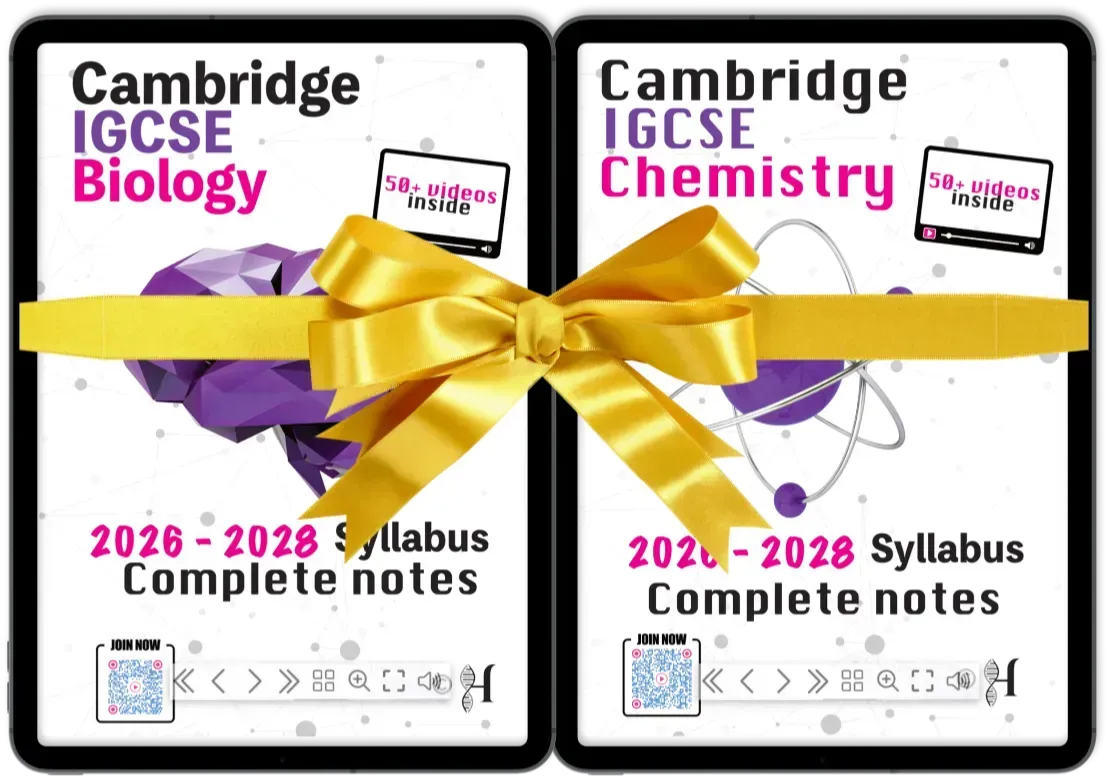
Cambridge IGCSE Biology and Chemistry Complete Notes eBooks tied together with a gold gift ribbon
Best value Save $10

Cambridge IGCSE Biology + Chemistry bundle

Both Cambridge IGCSE science books in one purchase — the complete 0610/0970 Biology notes and 0620/0971 Chemistry notes.

  • Cambridge IGCSE Biology — 0610 & 0970 (Papers 2, 4 & 6)
  • Cambridge IGCSE Chemistry — 0620 & 0971 (Papers 2, 4 & 6)
$40 $50

Or buy the Chemistry book on its own

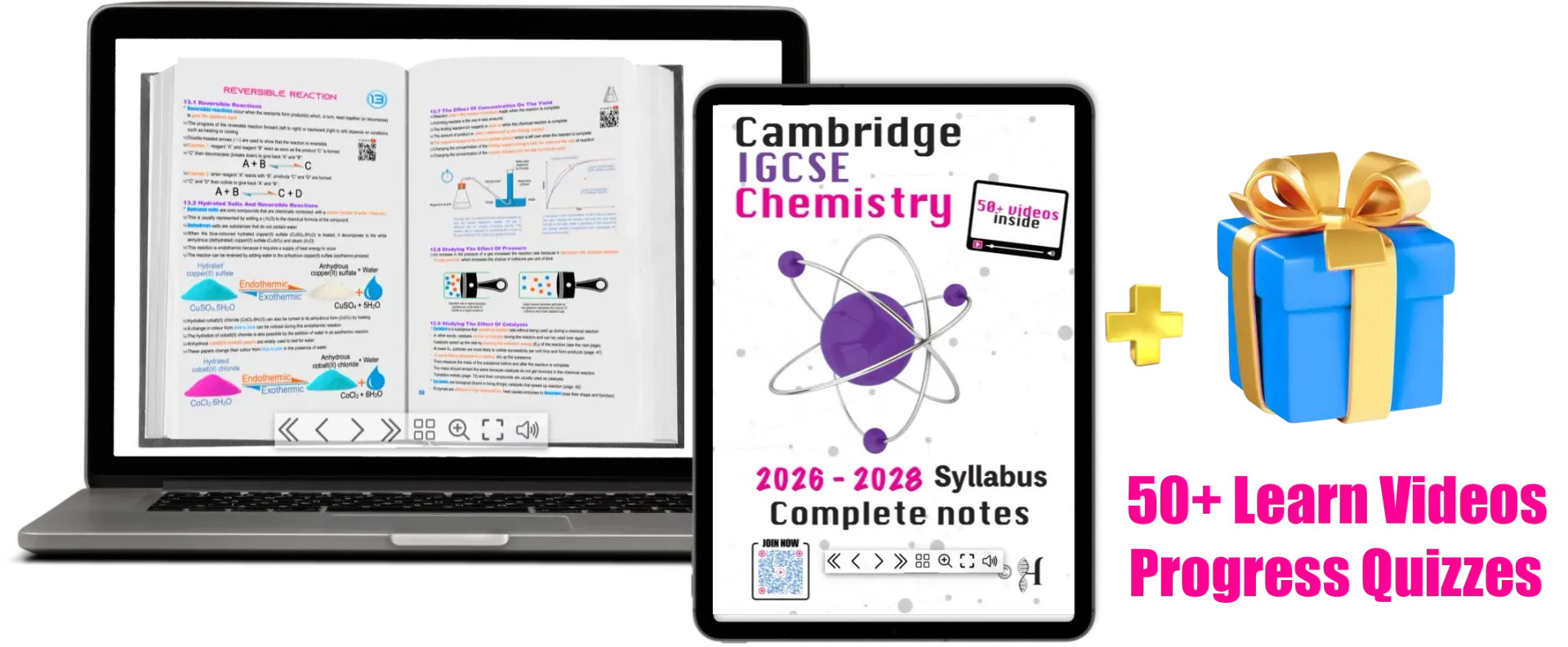
Cambridge IGCSE Chemistry Complete Notes eBook (0620, 0971) shown on a laptop and tablet 0620 & 0971

Cambridge IGCSE Chemistry — Complete Notes

Full Core and Extended coverage of Papers 2, 4 and 6, worked calculations, Paper 6 support, videos and quizzes.

$25

Format:
eBook — phone, tablet and computer
Access:
online, straight after purchase
Updates:
revised when the specification changes
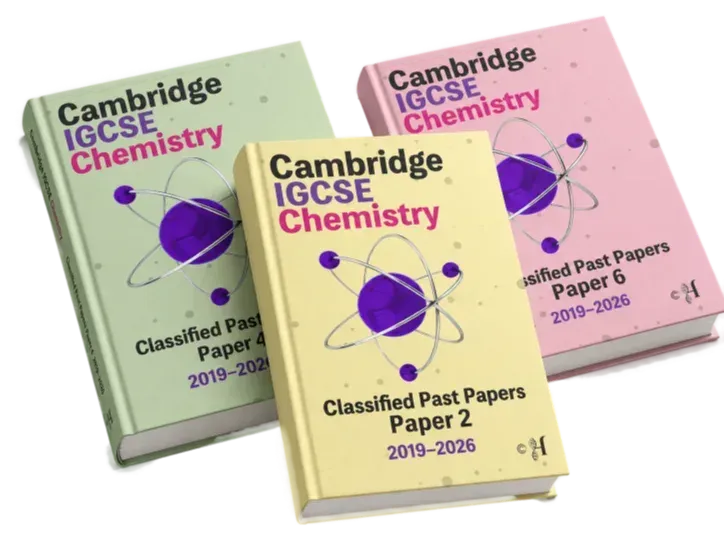
Cambridge IGCSE Chemistry classified past papers 2019–2026 for Papers 2, 4 and 6

OPTIONAL COMPLETE COURSE

Need someone to teach the calculations step by step?

The eBook is a complete standalone revision resource.

The Cambridge IGCSE Chemistry eBook covers syllabus codes 0620 and 0971 in full. The complete course adds full video teaching, guided calculation methods, solved past papers, Paper 6 practical training, quizzes and structured progress support.

  • 60 full video lessons
  • Step-by-step calculation teaching
  • Solved past-paper walkthroughs
  • Paper 6 practical training
Explore the Cambridge IGCSE Chemistry Course

Your eBook remains a complete resource. The course is an optional additional level of teaching and support.

Cambridge Chemistry students

What Chemistry students report

IGCSE Chemistry

“Every answer matches exactly what the mark scheme asks for. No extra detail, no wasted sentences — just the right words in the right order. My Chemistry grade jumped a full grade after using them.”

Abdulaziz Al-Enezi · Saudi Arabia
IGCSE Chemistry

“Our teacher gave us a 400-page textbook. The eBook gave me the same content in a fraction of the pages — and every point was something the mark scheme actually awards.”

Farida El-Sayed · Egypt
IGCSE Chemistry

“IGCSE Chemistry became much less overwhelming once each topic was reduced to the essential ideas, equations and mark-scheme wording.”

Majed Al-Subaie · Saudi Arabia
IGCSE Chemistry

“The Paper 6 experiment support helped me understand why each step is done, instead of memorising methods without understanding them.”

Ismail Rasheed · Maldives
All eBooks

“It feels like someone has taken a huge textbook and removed everything that will not help me score.”

Ozan Kaya · Turkey
All eBooks

“The chapters are concise enough for quick revision but complete enough that I never feel a syllabus point has been skipped.”

Zeeshan Tariq · Pakistan
Hosni, the science author and examiner who writes the Chem-Bio eBooks

Written by Hosni

Cambridge IGCSE Chemistry 0620 is taught in these books by the same teacher who wrote them: 21+ years teaching these exact syllabuses, 9 years writing the books, 5 published textbooks — and 20,000+ copies sold yearly across 40+ countries.

Before you choose

Cambridge IGCSE Chemistry questions

Cambridge IGCSE Chemistry 0620 and 0971, both Core and Extended tiers, across Papers 2, 4 and 6, mapped to the 2026–2028 syllabus.
Yes. Mole, concentration, yield and empirical-formula problems are solved step by step, with units carried through every line so you can follow the method.
Yes. Every required experiment is explained with apparatus, method and the reasoning the Paper 6 mark scheme expects.
It is designed as an exam-focused study and revision resource covering the full 0620/0971 syllabus. Use it alongside your school’s course requirements and past papers.
Yes — mapped to the current 0620 and 0971 syllabus and revised whenever Cambridge changes the specification.
The book supports both Cambridge IGCSE Chemistry syllabus codes: 0620, which uses the A*–G grading scale, and 0971, which uses the 9–1 grading scale. The subject content is the same, so students following either code can use the book while selecting the correct papers and grade information for their own examination entry.
Yes. Students do not need separate Chemistry notes for the two grading routes. The book covers the shared Cambridge syllabus content, calculations, practical skills and examination techniques used for both 0620 and 0971.
The book supports students following the Core and Extended routes. Extended material is presented clearly and systematically so students can recognise the additional knowledge and calculations required for their examination papers.
Yes. Calculations are presented as repeatable methods rather than unexplained formulas. Students can see what information to extract, which equation to use, how to substitute or rearrange values, how units should be handled and how the final answer should be presented.
The calculation support covers the quantitative skills required by the Cambridge syllabus, including mole calculations and related chemical arithmetic. Worked examples are structured so students learn a process they can apply when the numbers or context change in the examination.
Yes. Worked methods begin by showing students how to identify the information given, determine what the question is asking and select the correct relationship. This helps bridge the gap between remembering a formula and knowing how to apply it independently.
Yes. Paper 6 preparation includes experimental planning, variables, apparatus, observations, tables, graphs and conclusions. It also helps students distinguish between what they observe during an experiment and the scientific explanation for that observation.
Equations, state symbols, reagents, conditions and reaction patterns are presented together where appropriate. This helps students avoid remembering the reaction while forgetting the catalyst, temperature, pressure, state symbol or balanced equation needed for the mark.
Related reactions, groups and trends are compared in concise tables rather than hidden inside long paragraphs. Students can see similarities, differences, conditions and observations together, making the content easier to revise and retrieve under examination pressure.
Yes. Frequent traps are highlighted, including incorrect units, significant figures, state symbols, incomplete observations and answers that explain a reaction when the question only asks students to state what they can see.
The notes are supported by linked explanations and active-recall activities where indicated. Students can use these when a written example is not enough or when they need to check that they can remember a method without looking at the answer.
Students should use the notes to learn the method behind a topic before attempting questions. After marking a paper, they can identify whether the problem was missing knowledge, an incorrect calculation method, weak terminology or a practical-question trap and revise that specific weakness.
Yes. Unnecessary wording is removed, but required syllabus ideas, equations, definitions, practical details and examination points are retained. The purpose is to make revision faster without reducing the depth students need for their papers.
Access is available for two years from the date of purchase. Students can use the book during their course, return to earlier calculations and topics, and continue accessing it throughout final revision and examination preparation. ---

Make every Chemistry answer count

Get the complete Cambridge IGCSE Chemistry notes and stop losing marks to vague wording.

Want guided lessons and fully explained past papers? Explore the complete Cambridge IGCSE Chemistry course.