Edexcel IAL Chemistry periodic table and Data Booklet: what you get in each paper and how to use it
The periodic table is on the back cover of every paper; the Data Booklet is only for Units 2, 4 and 5. Both are below, with an Mr calculator.

- Periodic table
- M r calculator
- Which papers allow the booklet
- What is in the booklet
- What is not in it
- Official copy
Every unit reduced to the ideas, equations and exact wording that score, with the formulae and the organic functional groups the Data Booklet leaves out. Instant access on phone, tablet and computer.
$25 for the complete AS book · $15 for one unit
See inside the notesSitting Unit 1 on 11 January? The live revision course has started, and every session is recorded — $100. See the 12 sessions
Do you get a periodic table in the Edexcel IAL Chemistry exam?
Yes. The Edexcel IAL Chemistry periodic table is printed on the back cover of every question paper, in all six units. You do not bring one and you do not need the Data Booklet to see it.
The front page of each of Pearson's six sample papers carries the same line, "There is a Periodic Table on the back page of this paper", and the January 2025 Unit 1 paper says "A Periodic Table is printed on the back cover of this paper". I compared the two tables. They are the same: elements 1 to 111, each with its relative atomic mass to one decimal place, its symbol, its name and its atomic number.
That one decimal place matters. Chlorine is 35.5 , copper is 63.5 , magnesium is 24.3. If you learned 24 for magnesium at IGCSE, the paper in front of you says otherwise, and the mark scheme follows the paper.
The IAL Chemistry periodic table, as printed on your paper
Tap any element. The values are the ones Pearson prints on the back cover; the electronegativity is the one in the Data Booklet.
Swipe the table sideways to see every group.
How I teach students to use it
I strongly recommend that you get to know this table before the exam, not during it. In my classes we do two things on a printed copy.
- We mark the state symbols. You can read the state of every element at room temperature straight off the table: eleven gases, two liquids (bromine and mercury), and the rest solids. Once they are marked, state symbols in equations stop costing marks. Press "Show state symbols" above to see them.
- We draw the ladder from boron to astatine. I call it the bat line. Metals sit to its left and non-metals to its right, so you can tell at a glance whether a compound is likely to be ionic or covalent. Press "Show the metal / non-metal line".
One warning: nothing you write on the periodic table or on the data sheet is marked. Use them for thinking, and put every answer in the answer space.
M r calculator with the exam's values
Type a formula and the calculator adds it up with the relative atomic masses printed on your paper, line by line, so you can check your own working.
If a question prints its own values, for example "[A r values: H = 1.0 C = 12.0]", use those. Otherwise use the back cover.
Which papers allow the Data Booklet?
Units 2, 4 and 5 only. In Units 1, 3 and 6 you have the periodic table on the back cover and nothing else.
Pearson's specification says of WCH12, WCH14 and WCH15, and of no other unit, "This paper will contain questions that require information from the Data Booklet". The front pages agree: the Unit 2, 4 and 5 papers list "Scientific calculator, Data Booklet, ruler" under "You must have", while Unit 1 lists "Scientific calculator, ruler".
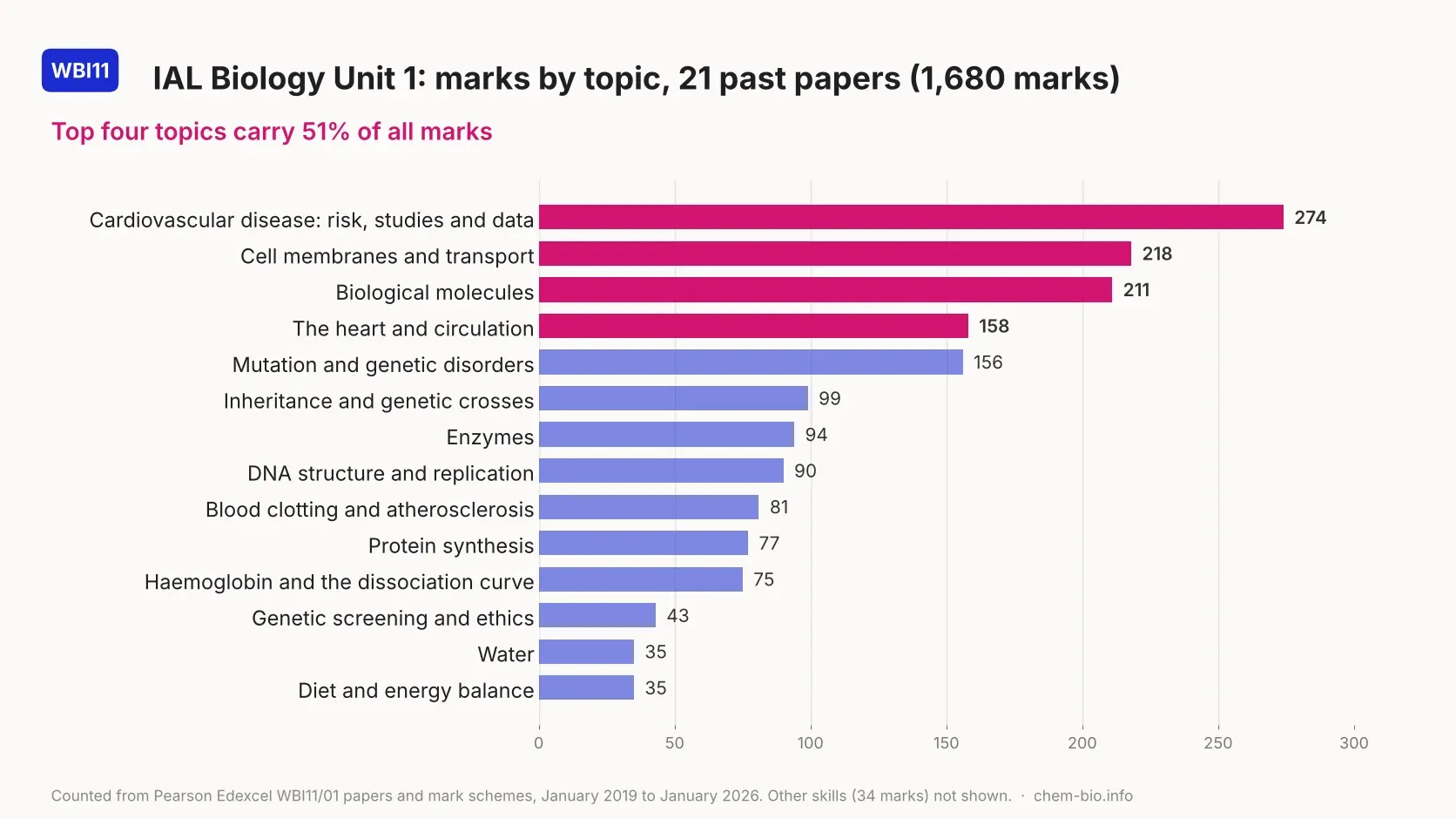
So what happens in Unit 1, where you need the gas constant and the Avogadro constant? The question gives them to you. In the 16 Unit 1 papers from May 2019 to January 2025 in my solved-paper books, all 16 print the ideal gas equation, pV = nRT, inside the question , and almost all print R = 8.31 J mol −1 K −1 beside it. January 2025, question 24(a)(i), is a typical one: four marks for the moles of a vaporised liquid, with the equation and R handed to you. Students rarely expect that. If Unit 1 is your next paper, the topics that come up most in WCH11 are counted here.
What is in the IAL Chemistry Data Booklet?
Six sections, set out in Appendix 9 of the specification. The table shows what each one gives you, where the specification examines it, and a question from a real paper that uses it.
| Section | What it gives you | Examined in | A question that uses it |
|---|---|---|---|
| Physical constants | Avogadro constant, elementary charge, gas constant, molar volume of a gas at r.t.p. (24 dm³ mol −1 ), ionic product of water, and 1 dm³ = 1000 cm³ = 0.001 m³ | Unit 4 (K w , point 14.10). In Unit 1 the constants are printed in the question instead | Unit 3, October 2023, Q2(e): why a measured molar volume is lower than "the Data Booklet value" |
| Infrared spectroscopy | Wavenumber ranges for C–H, N–H, O–H, C=C, C=O and triple bonds | Unit 2 (point 10.22); used again for structure problems in Units 4 and 5 | Unit 2, January 2023, Q16: match two peaks to one of four compounds |
| NMR chemical shifts | Charts of 1 H and 13 C chemical shifts relative to TMS | Unit 4 (points 15.18 to 15.20); Unit 5 organic synthesis | Unit 4, June 2023, Q19: name an isomer from its NMR spectrum |
| Pauling electronegativities | A value for each element from hydrogen to astatine | The idea is taught in Unit 1 (point 3.13); the booklet values are used in Unit 2 for polarity and intermolecular forces | Unit 2, January 2024, Q3: choose the compound with non-polar bonds, "Use the Data Booklet" |
| Indicators | Ten indicators with pK in , pH range and both colours | Unit 4 (point 14.16: choose an indicator from a titration curve) | Unit 4, January 2023, Q21: explain why phenol red suits the titration |
| Standard electrode potentials | 31 half-equations with E ⊖ values, from sodium (−2.71 V) to hydrogen peroxide (+1.77 V) | Unit 5 (points 16.2 to 16.14) | Unit 5, June 2022, Q3: the final colour when thiosulfate reduces vanadate(V) |
How often does each one come up? In my books, NMR appears in all 18 Unit 4 papers set between 2020 and January 2026, and electrode potentials in at least 14 of the 17 Unit 5 papers. Those two sections are not optional reading. The Unit 4 page and the Unit 5 page list the topics behind them.
How do you use each section to score?
Quote the value, then say what it shows. A number copied from the booklet earns nothing until you link it to the chemistry.
- Infrared. Name the bond and the range together: "the absorption at 1710 cm −1 is the C=O stretch of a ketone (1720–1700 cm −1 )". Then say what is absent, which is often the second mark.
- Electronegativity. Work out the difference for each bond first, then decide whether the bonds are polar, and only then whether the dipoles cancel. A molecule can have polar bonds and no overall dipole.
- Indicators. Read the vertical section of the titration curve, then choose the indicator whose whole pH range sits inside it. Give both colours for the end-point.
- Electrode potentials. Write the two half-equations as the booklet prints them, state which is more positive, and calculate E ⊖ cell . A positive value means the reaction is thermodynamically feasible, not that it is fast.
- NMR. Use the chart for the shift, the splitting for the neighbours and the peak areas for the number of protons. Papers warn when a real shift differs from "the general values in the Data Booklet", so read that sentence.
The papers often tell you where to look, with lines such as "Refer to page 10 of the Data Booklet". Know your way round it before the day. The full list of what each unit examines is on the IAL Chemistry specification checklist.
What is not in the booklet and must be learned?
No formulae and no organic functional groups. Students expect both, laid out the way a textbook does it, and the booklet has neither.
There is no list of equations for moles, concentration, enthalpy change or pH, no table of functional groups, no reaction conditions and no reaction pathways. All of that has to be in your head. This is why the booklet in my complete AS Chemistry notes sets out the formulae and every organic functional group, and why I give students one map of all the organic reactions they need for AS and another for A2.
The surprise runs the other way too. The ideal gas equation, which most students think they must memorise, is printed in the question in every Unit 1 paper I counted.
Where is the official Data Booklet?
On Pearson's website. The data is shown in Appendix 9 of the specification (pages 99 to 104), and Pearson says there that the booklet is available on its website; start at the IAL Chemistry qualification page.
Print your copy from there rather than from a file-sharing site, where old GCE booklets with different pages are mixed in with the current one. The specification is clear on one rule: "Candidates must use an unmarked copy of the Data Booklet in examinations". Your centre provides a clean copy for the exam, so practise with a clean one as well.
Questions students ask
Is the Data Booklet allowed in IAL Chemistry Unit 1?
No. Unit 1 (WCH11) lists only a scientific calculator and a ruler. The periodic table is on the back cover, and constants such as R are printed in the question.
Is there a new Edexcel IAL Chemistry periodic table for 2026 or 2027?
No new version has appeared in the papers. The table on the January 2025 paper is the same as the one in the 2017 sample papers: elements 1 to 111, masses to one decimal place.
Is pV = nRT given in the IAL Chemistry exam?
In Unit 1, yes, inside the question. It appears in all 16 Unit 1 papers from May 2019 to January 2025 that I checked, usually with R = 8.31 J mol −1 K −1 .
Which relative atomic mass should I use for chlorine and copper?
Use the values printed on your paper: 35.5 for chlorine and 63.5 for copper. If the question gives its own A r values, use those instead.
Can I write on the Data Booklet in the exam?
You must be given an unmarked copy, and nothing written on it or on the periodic table is marked. Put all working and answers in the spaces on the question paper.
Print a clean periodic table, mark the state symbols and the bat line, and work one past-paper question for each booklet section. If you want the formulae, the functional groups and the reaction maps in one place, they are in the Edexcel IAL Chemistry notes.
Not ready to buy? Watch a full AS Chemistry lesson on ionic bonding first.
Try a free Class