
IGCSE Biology Paper 6: The Marks by Skill, the Drawing Rules and How to Reach 36 Out of 40
Forty marks in one hour, 20% of the grade. Where every mark sits, the four drawing checkpoints, and the grade A line for March and June since 2023.

TL;DR: IGCSE Biology Paper 6 is a one-hour, 40-mark written paper worth 20% of the grade that tests practical skills with no laboratory: recording and processing results, drawing a graph, making a large biological drawing, calculating magnification, planning an investigation and describing food tests. In Cambridge's own specimen paper the marks fall as recording 4, calculations 7, graph 3, drawing and magnification 7, planning 6, food tests 5, and variables, controls and conclusions 8. A grade A on the paper needed 28, 28, 31 and 31 out of 40 in the March series of 2023 to 2026 and 32 and 34 in June 2025 and 2026, and 36 is the mark I set my A* students. Students in India sit Paper 6 on Tuesday 16 February 2027; everyone else sits the same paper in June or November. Below is the mark map, the drawing and magnification rules, a five-step plan for the six-mark question, and the ten habits that take a script from 28 to 36.
On this page
- What is on IGCSE Biology Paper 6?
- Where the 40 marks sit: a skill-by-skill map
- How many marks do you need for a grade A, and why I set 36?
- The biological drawing: four marks, four checkpoints
- Magnification to three significant figures
- Tables, graphs and the numbers you read off them
- Planning an investigation: six marks in five steps
- Food tests, enzymes, yeast and osmosis: the contexts that keep coming back
- Ten habits that move a script from 28 to 36
- When is Paper 6, and is the March paper different?
- How to prepare for Paper 6 from now
- FAQ
What is on IGCSE Biology Paper 6?
IGCSE Biology Paper 6, the Alternative to Practical, is a written paper of 1 hour and 40 marks that carries 20% of the Cambridge IGCSE Biology grade and tests experimental skills without any experiment being carried out. The Cambridge IGCSE Biology 0610 syllabus for 2026, 2027 and 2028 says that candidates "will not be required to do experiments as part of this test", that every question is based on the experimental skills in Section 4 of the syllabus, and that the paper tests assessment objective AO3 only.
Your school enters you for either Paper 5, a practical test of 1 hour 15 minutes in a laboratory, or Paper 6. The syllabus states that the two papers "require the same experimental skills to be developed and learned", "require an understanding of the same experimental contexts" and "test the same assessment objective, AO3". The difference is that Paper 6 hands you the results, the photograph and the diagram and asks what a competent experimenter would do with them.
That makes Paper 6 the one paper in IGCSE Biology where the content is almost fixed and the marks are for habits. The same syllabus lists the contexts you can be asked about: simple quantitative work with volumes, masses, temperatures, times and lengths; diffusion; osmosis; food tests; rates of enzyme-catalysed reactions including judging end-points by colour change; pH and indicators; photosynthesis; transpiration; heart and breathing rate; respiration; tropic responses; seed and flower dissection; germination; variation and sampling; and observing and drawing specimens. There is no new biology in any of them. There is a set of skills, and skills are learned slowly, which is why this is the paper to start in October rather than the week before.
Where the 40 marks sit: a skill-by-skill map
The 40 marks on Paper 6 are spread across seven skills, and in Cambridge's specimen paper they fall as recording 4, calculations 7, graph 3, drawing and magnification 7, planning 6, food tests 5, and variables, controls and conclusions 8. Those figures come from the Cambridge specimen Paper 6 for 0610, the paper published to show the format used from 2023 onwards, which is built from two long questions: catalase in cooked and uncooked potato (21 marks) and the respiration rate of woodlice in a respirometer (19 marks). Live papers spread the same skills over more questions, but the balance of marks is what matters, and the table below maps each skill to what the specimen mark scheme awards it for.
| Skill | Marks in the specimen | What the mark scheme awards | The habit that earns it |
|---|---|---|---|
| Reading and recording results | 4 | A table "drawn with header lines", "headings with units", every value entered; a reading taken from a diagram | Independent variable first column, unit in the heading with a solidus, no units in the cells |
| Calculations | 7 | A difference, a rate "in mm per minute" to 1 decimal place, a missing mean, a rate per gram | Write the formula, show the working, give the unit, round only at the end |
| Graph or chart | 3 | Axes labelled with quantity and unit; a scale that "occupies at least half the grid on both axes"; bars "do not touch and are the same width", plotted to half a small square | Check the scale before the first point; ruler for every line |
| Biological drawing and magnification | 7 | "Single clear line and no shading"; "equal to / larger than, original"; the counted details; PQ measured ±1 mm; the correct calculation; "three significant figures" | Large, clean outline; count what you draw; measure in mm; round last |
| Planning an investigation | 6 | Independent variable, two constants, dependent variable, method detail, a control, "two or more replicates", "relevant safety precaution" | The five-step method below, written as numbered steps |
| Food tests | 5 | "add iodine solution", "blue-black"; "add Benedict's solution", "heat (to 80 °C)", "(brick-)red / yellow / orange / green" | Reagent, condition, colour: all three, every time |
| Variables, controls, errors and conclusions | 8 | The independent variable named; why cylinders must be identical; two constants; a source of error; a control; a conclusion from the data | Name the variable precisely and quote a number in every conclusion |
Marks and quoted wording from the Cambridge 2023 specimen Paper 6 and mark scheme for 0610; the habits column is mine.
Two things in that table decide your revision. First, 22 of the 40 marks (recording, calculations, graph and food tests plus the variables group) are one-mark lines with a fixed form of words, and a drilled student writes them in seconds. Second, the two blocks that cost my students the most, planning and the drawing-plus-magnification pair, are only 13 marks between them, yet they are where the gap between a grade A and an A* on this paper lives. The rest of this post takes the skills in that order of value.
How many marks do you need for a grade A, and why I set 36?
A grade A on Paper 62 has needed 28, 28, 31 and 31 marks out of 40 in the March series of 2023, 2024, 2025 and 2026, and 32 and 34 in June 2025 and June 2026, so the mark I set my A* students is 36. Cambridge does not award A* on a single paper, but it publishes a grade A threshold for every component, and those figures come from the Cambridge threshold tables for March 2023, March 2024, March 2025, March 2026, June 2025 and June 2026.
So a grade A has been 70% to 85% of the paper depending on the series, and the June line has sat above the March line in both of the last two years. An A* at syllabus level has needed between 153 and 174 of the 200 weighted marks across those six series, which is 77% to 87%, and every Paper 6 mark counts exactly once in that total: 40 raw marks carrying 20% of 200. There is no multiplier to rescue a weak Paper 6, and no multiplier to punish it either. What you score is what you get.
Why 36 and not 34? Because the thresholds move. A student trained to 34 who meets a June-2026-style paper has no margin; a student trained to 36 has two marks to lose on the one question that surprises them. I am proud to say that many of my students scored close to full marks on this paper in the 2026 series. One of them had a D in his mid-year mock. He finished with a 9 on the 0970 scale, the A* equivalent, and when we looked at his script breakdown the Paper 6 line read 40 out of 40. That is what this paper rewards: not more biology, but the habits below, practised until they are automatic.
The biological drawing: four marks, four checkpoints
The biological drawing is worth four marks in the specimen and the mark scheme awards them for one clean outline with no shading, a drawing at least as large as the original, and two counted details that prove you looked. The specimen asks for "a large drawing of the woodlouse" and credits "single clear line and no shading", a size "equal to / larger than, original", "at least eight distinct segments" and "two projections at the front and two at the back". The 0610 syllabus adds the rules behind those points: a sharp pencil, fine, clear, unbroken lines, a drawing that "should use most of the available space and show all the features observed in the specimen", "no shading or use of colour", and label lines drawn with a ruler that touch the feature they name.
Here is the same four-mark pattern on a live question, a tomato cut in half, solved in my Paper 6 flipbook with the mark scheme and the Cambridge note on what went wrong beside it.
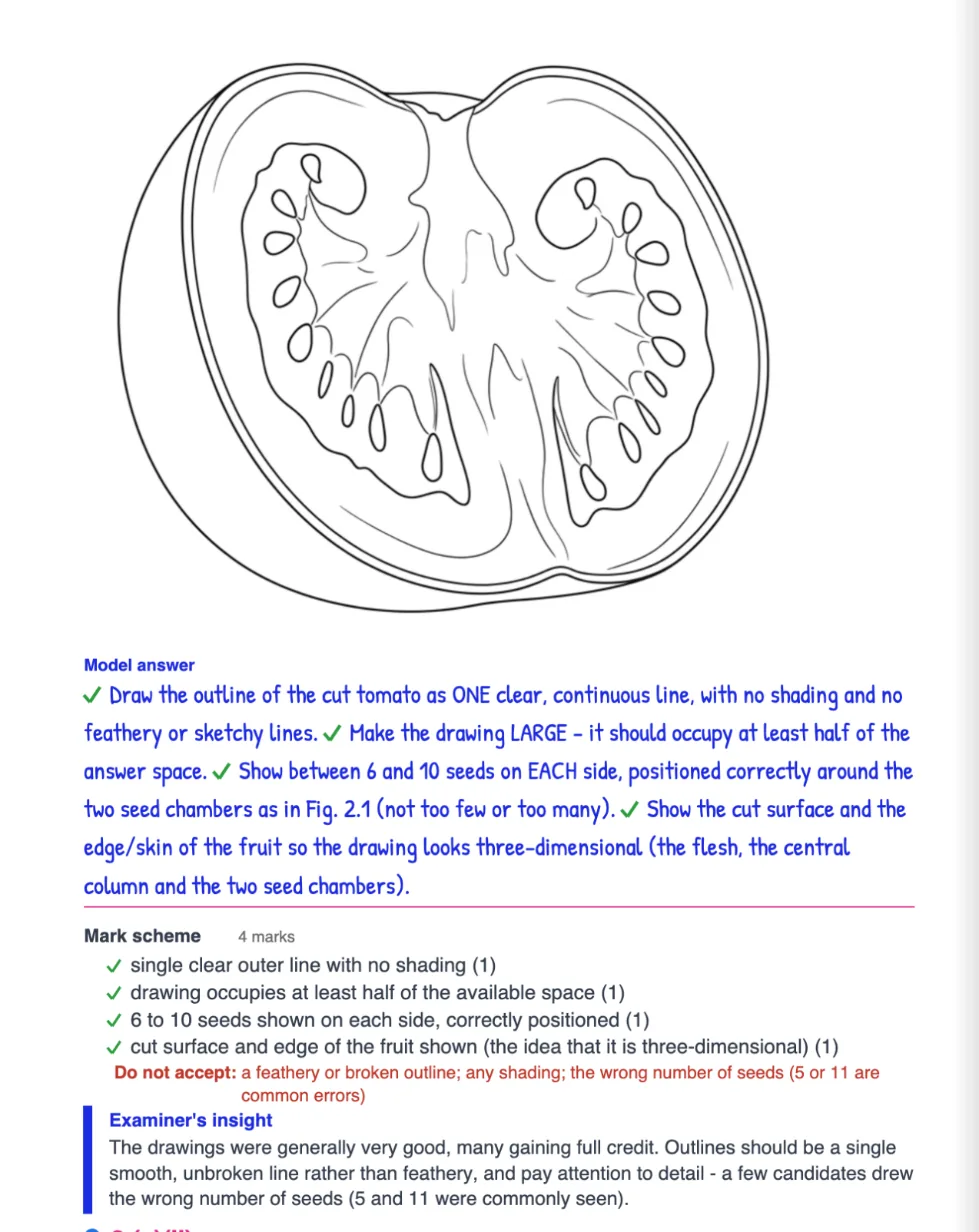
From my solved Paper 6 flipbook: one continuous outline, at least half the space, six to ten seeds on each side, and the cut surface shown. Five or eleven seeds lost the detail mark.
The four checkpoints, in the order I teach them:
- One continuous outline. No sketching, no feathery strokes, no going over a line twice. If the line is wrong, rub it out and draw it once.
- Large. At least half the space given, and larger than the original image if the question says "large". Small drawings lose the size mark before anything else is looked at.
- Count the details. If the specimen has eight segments, draw eight. If there are six to ten seeds a side, draw six to ten, not five and not eleven. The detail marks are counted, not judged.
- Keep looking back at the original. The commonest way to lose a mark is to add a structure that is not in the image because you remember it from a textbook. You are drawing what is in front of you, not what a tomato usually looks like.
No shading, no colour, and no labels unless the question asks for them. These four or five marks are the easiest on the paper to secure, and they are the ones my students most often throw away by rushing.
Magnification to three significant figures
Magnification appears on every Paper 6 I have solved, and the three marks are for measuring the line to the nearest millimetre, dividing correctly, and rounding to the number of significant figures the question states. The specimen gives a line PQ across the woodlouse drawing at a stated magnification and credits "length of PQ 48 (mm) ± 1 mm", the correct division, and "correct rounding to three significant figures", with error carried forward on the second and third marks if the measurement is out.
The question gives you the formula, so the marks are for discipline, not memory. Here is a live example from my flipbook: cells from a red onion at magnification ×340, the line PQ across cell X measured at 70 mm, and the actual length worked as 70 ÷ 340 = 0.206 mm.
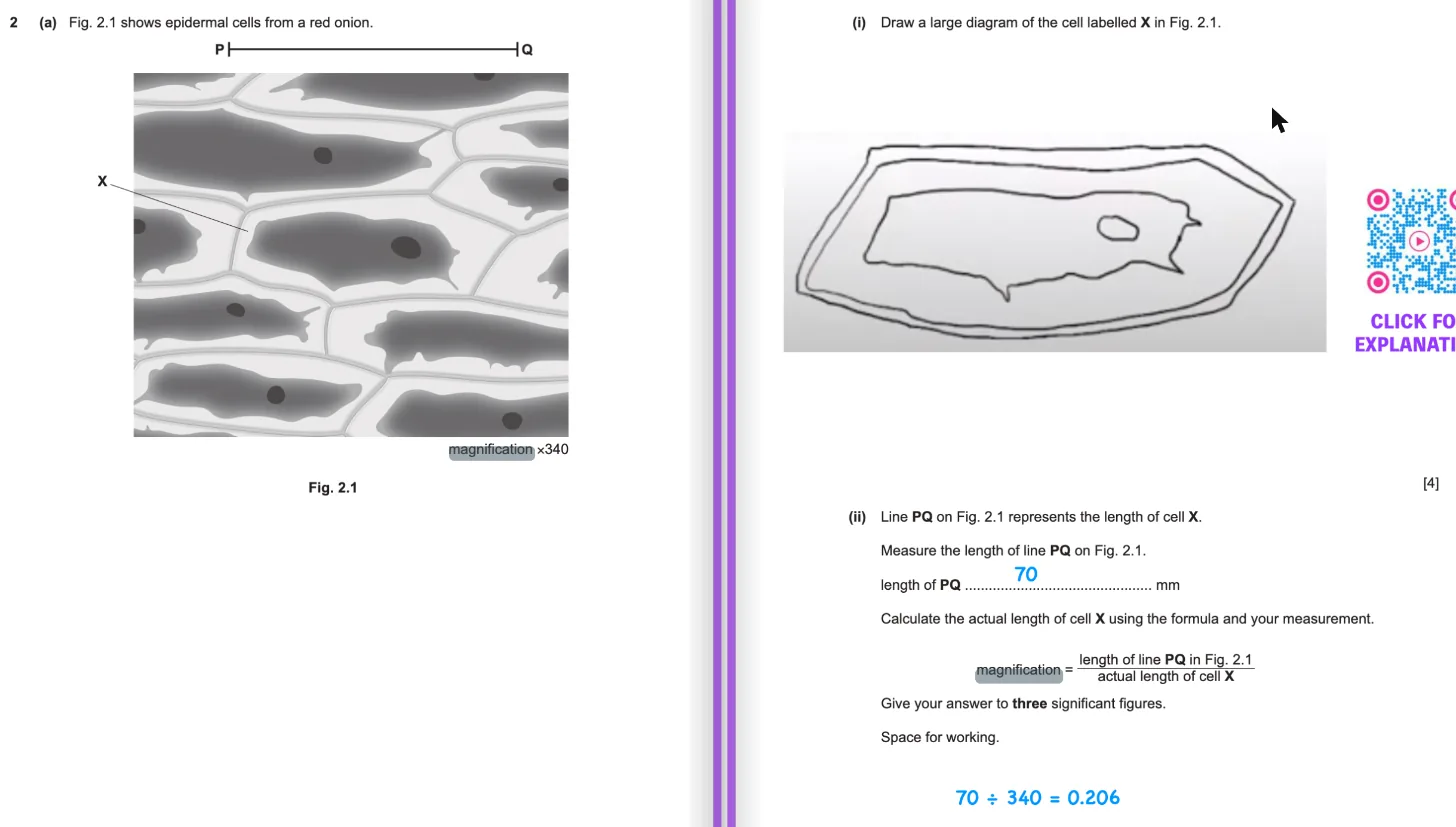
The drawing-and-magnification pair as it appears on a live paper: a large drawing of cell X, then PQ measured in millimetres and divided by the magnification to three significant figures.
The three mistakes I correct every year, in order of frequency: measuring in centimetres and then dividing a 7 by 340; rounding the line measurement before dividing; and writing 0.2 when the question asked for three significant figures. The mark scheme's general rule, that a missing or incorrect unit "will normally mean that the final calculation mark is not awarded", applies here as everywhere on the paper. Write the unit.
Tables, graphs and the numbers you read off them
Tables and graphs earn their marks against a fixed set of rules that Cambridge prints in the syllabus, and the marks are lost in the same five places every series. The syllabus says that column headings carry the quantity and the unit separated by a solidus, that "units should not be included with data in the body of a table", that each point is plotted "to an accuracy of one half of one of the smallest squares on the grid", that the independent variable goes on the x-axis, and that scales should use more than half the grid in both directions.
For graphs, the rule I give is simpler than the syllabus and never fails: if the points are joined, use a ruler and join them point to point with straight lines, unless the question clearly asks for a smooth curve or a line of best fit. The specimen's three graph marks are for a bar chart, and the mark scheme wants axes labelled with quantity and unit, a scale that "occupies at least half the grid on both axes", and bars that "do not touch and are the same width", plotted to half a small square. Leave gaps between bars unless you are asked for a histogram, which is rare.
For the numbers, three habits:
- Percentage change is (change ÷ original) × 100, and the sign matters. A potato cylinder that goes from 2.40 g to 2.10 g has changed by −12.5%, not 12.5%.
- Rates are change ÷ time with the unit the question uses. The specimen asks for a rate "in mm per minute" to one decimal place; write the division, then the answer, then the unit.
- Reading off a graph means drawing the construction lines on the grid. A value read by eye is a value the mark scheme cannot see.
My IGCSE Biology and Chemistry notes eBook has the table, graph and drawing rules on one page so they can be revised together before a mock.
Planning an investigation: six marks in five steps
The planning question is worth six marks and it is where my Biology students lose the most, because the marks are for naming the variables correctly and writing a method someone else could follow, not for knowing the biology. Students who have not practised enough past-paper plans lose two or three of the six as a minimum. The specimen's plan asks whether catalase activity is the same in all plant species, and the mark scheme credits: at least two different species (the independent variable); up to two constants from a list that includes the same volume and concentration of hydrogen peroxide, the same temperature, the same pH, the same time, and tissue from the same part of the plant; a way of measuring the dependent variable (foam height, volume of oxygen, or counting bubbles); detail of the method such as how the plant material is prepared to the same surface area; a control with no plant or boiled plant; "two or more replicates"; and a "relevant safety precaution".
Here is the five-step method I teach for every plan, whatever the context:
- Read the question and find the factor you are asked to change. That is the independent variable. Say how many values you will use; two is the minimum and five is better.
- Find what you will measure. That is the dependent variable, and you must say how it is measured: foam height in mm, volume of gas in a gas syringe, the number of bubbles in a minute, the change in mass on a balance.
- Control at least two or three variables, chosen from the question. Temperature, volume, concentration, time and the size or source of the tissue are the usual ones.
- Write a safety precaution, and tie it to the investigation. Goggles and gloves are the right instinct, but the mark is for a precaution relevant to this experiment: gloves because hydrogen peroxide is an irritant, or keep hands away from the hot lamp.
- Repeat and average. Repeat each condition, ideally five times, calculate a mean and say that the repeats improve reliability and show up anomalies.
Here is the same method on a real June paper, planning the effect of light intensity on photosynthesis in an aquatic plant, with the eight marking points that Cambridge capped at six.
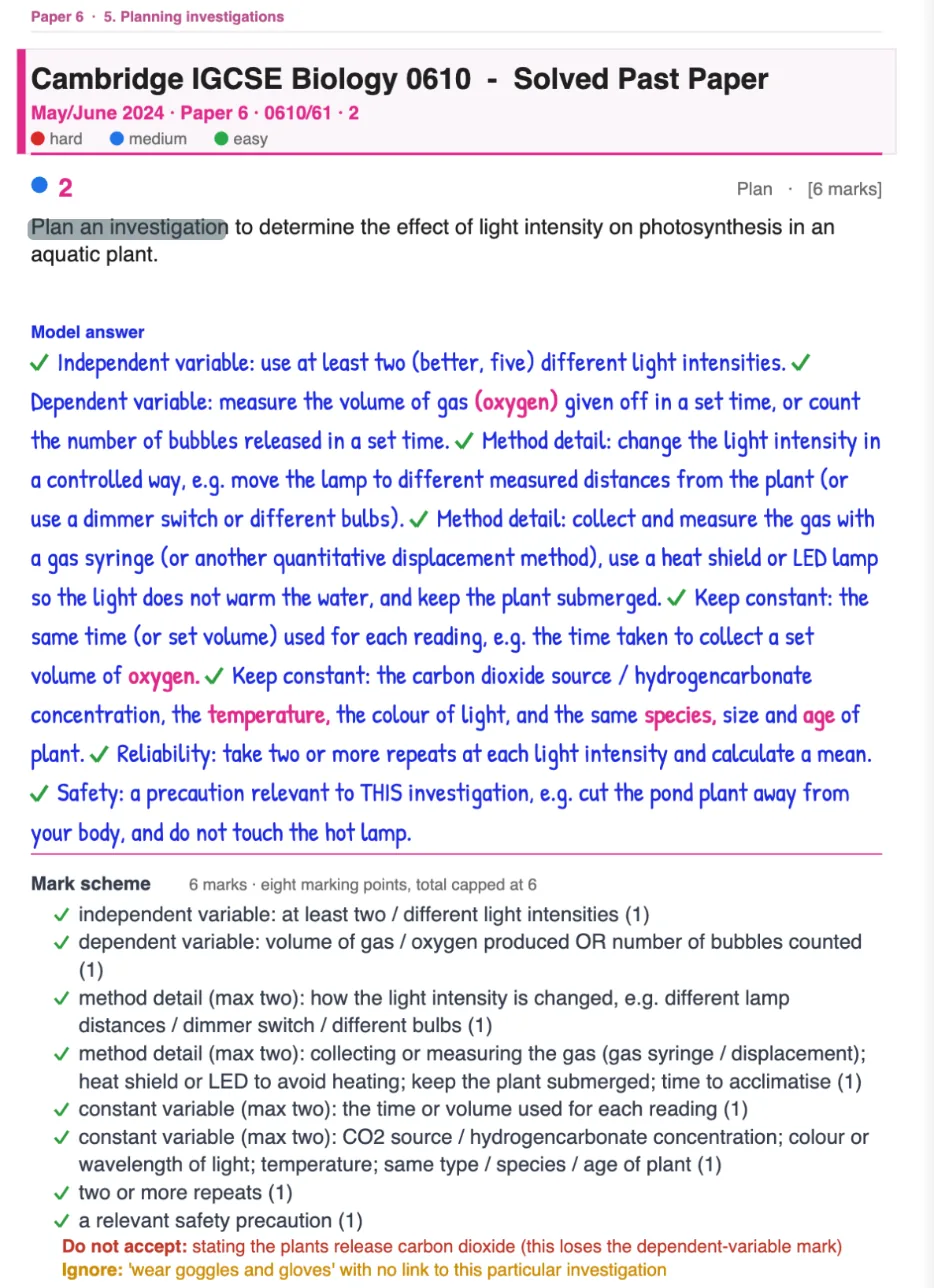
The six-mark plan, solved: independent variable, dependent variable with a measurement, two method details, two constants, repeats, and a safety precaution linked to the experiment.
And here is the same five steps written the way a student should write them in the exam, for osmosis in plant tissue: five concentrations of sodium chloride solution of the same volume; cylinders of the same size from the same onion; measure the initial mass; soak for 48 hours; calculate the percentage change in mass; repeat at each concentration and average; wear gloves.
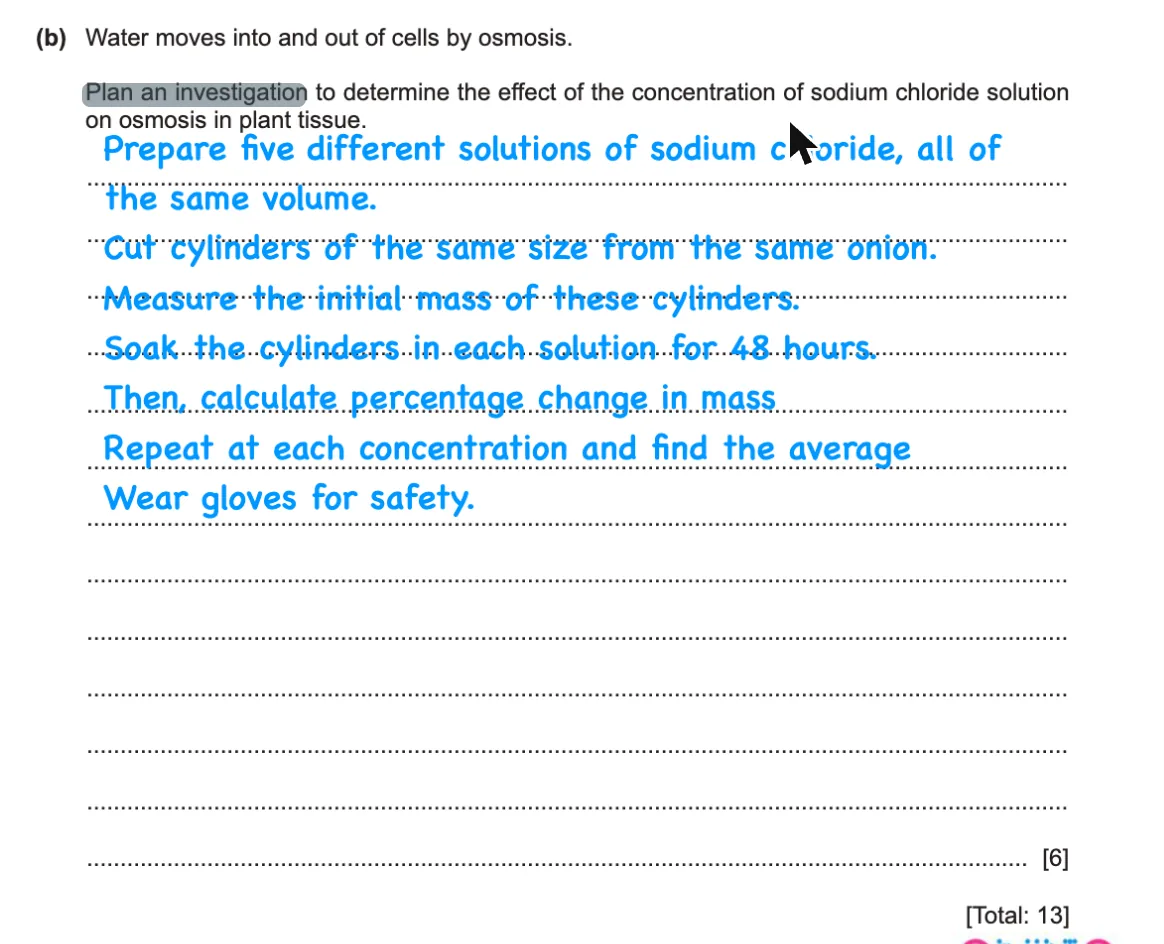
Seven lines, six marks: that is the length a plan needs. Each line carries one marking point and nothing else.
The commonest way to lose the dependent-variable mark is to describe the wrong thing being produced; the mark scheme for the light-intensity plan refuses "the plants release carbon dioxide" outright. Read the question, decide what is made or lost, and name it. I walk through the five steps on a yeast-and-sugar investigation in my video on how to secure all six marks in the Paper 6 planning question.
Food tests, enzymes, yeast and osmosis: the contexts that keep coming back
Four experimental contexts account for most of the Paper 6 questions I have solved in recent series: food tests, enzyme investigations with amylase or catalase, anaerobic respiration in yeast, and osmosis in plant tissue. Food tests are the cheapest marks on the paper. The specimen gives five for describing the tests for starch and reducing sugars, and the mark scheme wants the reagent, the condition and the colour: "add iodine solution", "blue-black"; "add Benedict's solution", "heat (to 80 °C)", and a positive result of green, yellow, orange or brick-red. Memorise every colour change, including the negative colour, because a question can ask for either.
Enzymes have been the most heavily tested context in recent sessions. Learn how to investigate amylase and starch, and catalase and hydrogen peroxide, as experiments and not as theory: what you measure, how you judge the end-point, and how temperature and pH are controlled. The six-mark plan is very often an enzyme plan. Say the enzyme is denatured at high temperature; a script that says the enzyme is "killed" loses the mark.
Anaerobic respiration in yeast is the second heavy context: a yeast-and-sugar mixture with the carbon dioxide collected in a gas syringe or counted as bubbles, and temperature and pH controlled. Osmosis is the third, and it comes in two forms, the effect of solution concentration on the mass or length of potato or onion cylinders, and the Visking tubing experiment. Make sure you can carry out both on paper and explain the results in terms of water potential, because the question often ends with an explanation worth two or three marks.
Those four contexts, plus the drawing, plus magnification, are the revision list I give students in the last few days before the paper. The IGCSE Biology course has each of them solved from past papers with the mark scheme beside every answer.
Ten habits that move a script from 28 to 36
The gap between a grade A and an A* on this paper is about eight marks, and it closes with ten habits that have nothing to do with knowing more biology. These come from years of my own students' scripts and from the Cambridge mark scheme wording, and they are the checklist I want you to read the night before.
- Fed, read, freeze. The independent variable is what you feed the experiment, the dependent variable is what you read, and the control variables are what you freeze. Name all three, precisely: not "temperature" but "the temperature of the water bath in °C".
- Say repeats, and say why."Repeat each concentration and calculate a mean to improve reliability and identify anomalous results" is worth more than "repeat the experiment".
- Put a number in every conclusion."As light intensity increased from 10 to 50 units, the rate rose from 2.1 to 8.4 bubbles per minute" earns the marks that "the rate increased" does not.
- Use the four words correctly. Reliability is consistency on repeating; validity is that only the independent variable changed; accuracy is closeness to the true value; precision is the fineness of the measurement. Adding repeats improves reliability, not accuracy.
- Read the introduction before the first question. A plant that bends in a sealed, lightless box is showing gravitropism, not phototropism, and the clue was in the first two lines.
- Describe, explain, suggest. Describe means say what you see; explain means give the reason; suggest means apply your knowledge to something new. Answering a describe question with an explanation wastes time; answering an explain question with a description loses the mark.
- Evaluate in three parts. Name the weakness, state the improvement, explain its effect. Judging a colour change by eye is the weakness; a colorimeter is the improvement; the end-point is measured the same way every time is the effect.
- Units in headings, never in cells, and a mean column whenever you repeated.
- Measure in millimetres, show the division, round last.
- Draw what is there. Large, one line, counted details, no shading, and keep looking back at the image.
These were the ten points of an earlier post on this site, and they are now here so that everything on Paper 6 lives on one page.
When is Paper 6, and is the March paper different?
Students in India sit Biology Paper 6 on Tuesday 16 February 2027 in the morning session, according to the Cambridge final timetable for the March 2027 series, with the theory paper two days later on 18 February and the multiple-choice paper on 4 March; the series runs from 3 February to 4 March and results come out on 13 May, as set out in the Cambridge key dates for the March series. Students sitting in June or November take Paper 6 on the date their school's timetable gives.
The paper itself is the same. The syllabus states that exams "are also available in the March series in India", on the same 0610 content and the same assessment objectives, and the threshold tables above show the two series held to one standard with the March paper graded a little lower: a grade A needed 31 out of 40 in March 2026 against 34 in June 2026, and 31 in March 2025 against 32 in June 2025. March is not an easier sitting; it is an earlier one, and the preparation has to be finished by the end of January rather than the end of April. If you are sitting the whole series in February and March, my guide to preparing for IGCSE Biology in the February/March 2027 series has all three dates, the A* and A thresholds and a 16-week plan.
How to prepare for Paper 6 from now
Prepare for Paper 6 one skill a week, not one paper a day in the final fortnight, because the marks are for habits and habits take repetition. The order I use with my own classes:
- Drawing. Five large drawings from past-paper photographs, each checked against the four checkpoints, before anything else.
- Magnification and percentage change. Ten calculations in millimetres, formula written, unit written, rounded last.
- Tables and graphs. Five results tables from raw data, five graphs with the scale checked first and a ruler on every line.
- Planning. A five-step plan for each of the four contexts: enzymes, yeast, osmosis and food tests, marked against the specimen's plan points.
- Full papers under time. From December for the March series, one Paper 6 a week in one hour, scored, every lost mark written next to the rule it broke. Work through the papers from 2020 onwards.
Start with the Paper 6 trial pack in the free sample lesson of my course: a worked Paper 6 with the observations, measurements and drawing scored against the mark scheme, open without a sign-in. Students in the full course get every Paper 6 from recent series solved with the mark scheme beside each answer, and the solved past papers bundle has the same papers for students who only want the practice. If you are not sure which practical paper your school has entered you for, or whether your child is on track for 36, message me on WhatsApp at +965 5137 5709 or email admin@chem-bio.info and I will reply personally.
FAQ
Is Paper 6 easier than Paper 5? Neither is designed to be easier: the syllabus says both papers test the same AO3 skills in the same experimental contexts and both are worth 40 marks and 20%. Paper 6 removes the laboratory, so the marks depend entirely on how well you record, draw, calculate and plan on paper.
Do you draw in pen or pencil in Paper 6? Pencil, and a sharp one: the syllabus asks for fine, clear, unbroken lines with no shading or colour, which cannot be done in pen. Label lines are drawn with a ruler and must touch the feature they name.
Does Paper 6 have the same questions every year? The contexts repeat but the questions do not: food tests, enzymes, yeast respiration, osmosis, a drawing and a magnification calculation appear in most series, each on a new specimen or set of results. Practise the skills on past papers from 2020 onwards rather than memorising any one paper.
How many marks is the planning question in Paper 6? Six marks in the specimen and in the recent papers I have solved, awarded for the independent variable, the dependent variable and how it is measured, two or three constants, method detail, repeats and a relevant safety precaution. It is the question my students lose the most marks on and the easiest to fix with practice.
Try a free Class


